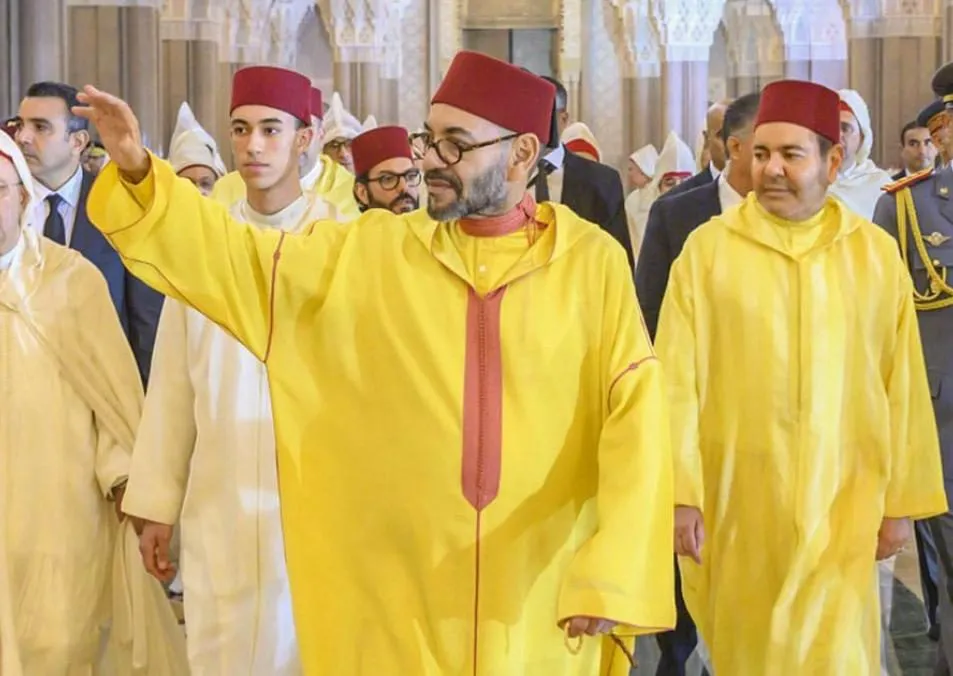
Non-Muslims can get inside the Hassan II Mosque only on the official guided tour, which costs 140 DH for an adult. Departures go out in Arabic, French, English, Spanish and Italian, each running 45 to 60 minutes. The minaret rises 210m above the Atlantic sea wall, and the waves break below the esplanade while you wait.
The Casablanca start
The Hassan II Mosque tour runs Saturday to Thursday at 09:00, 10:00, 11:00, 12:00 and 15:00. Friday drops to three departures, at 09:00, 10:00 and 15:00. Foreign students pay 70 DH, children aged six to 12 pay 30 DH, and under-sixes go free. Fix your departure time before anything else and build the day around it, because nothing else in the city runs on so short a timetable. Inside, the prayer hall sets titanium against zellij, the cedar roof retracts, and a glass floor lets you stand above the ocean.
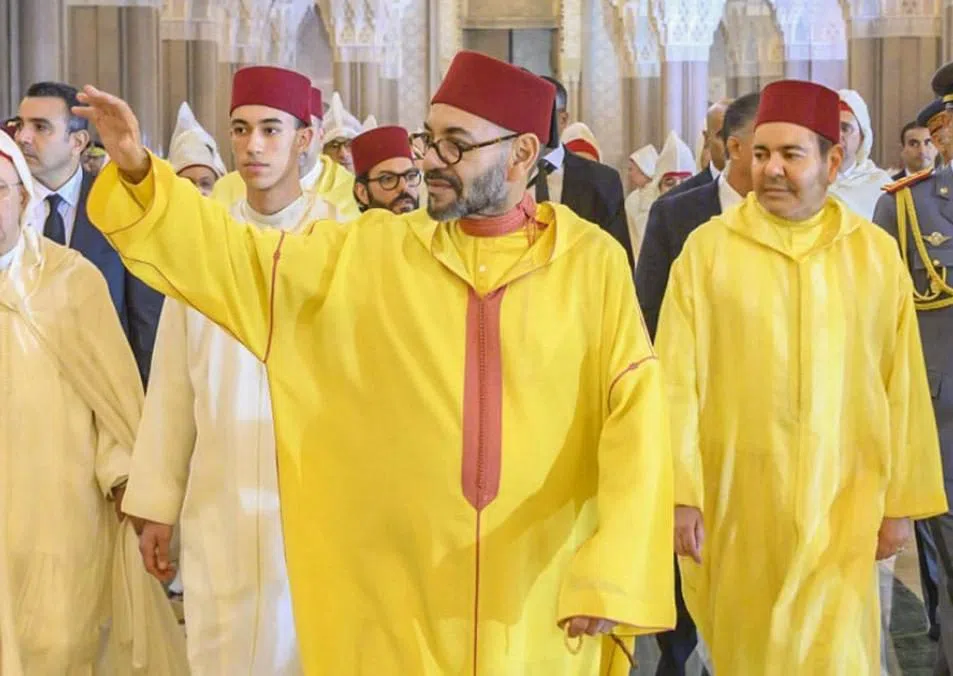
Quartier Habous, the New Medina, is a 1930s plan of arcaded pale stone, horseshoe arches and orange trees, and it is free to walk. The souk here sells carpets, babouches and spices, and the streets stay calmer and cleaner than the old medina's. Many shops close over lunch, so come in the morning or the late afternoon.
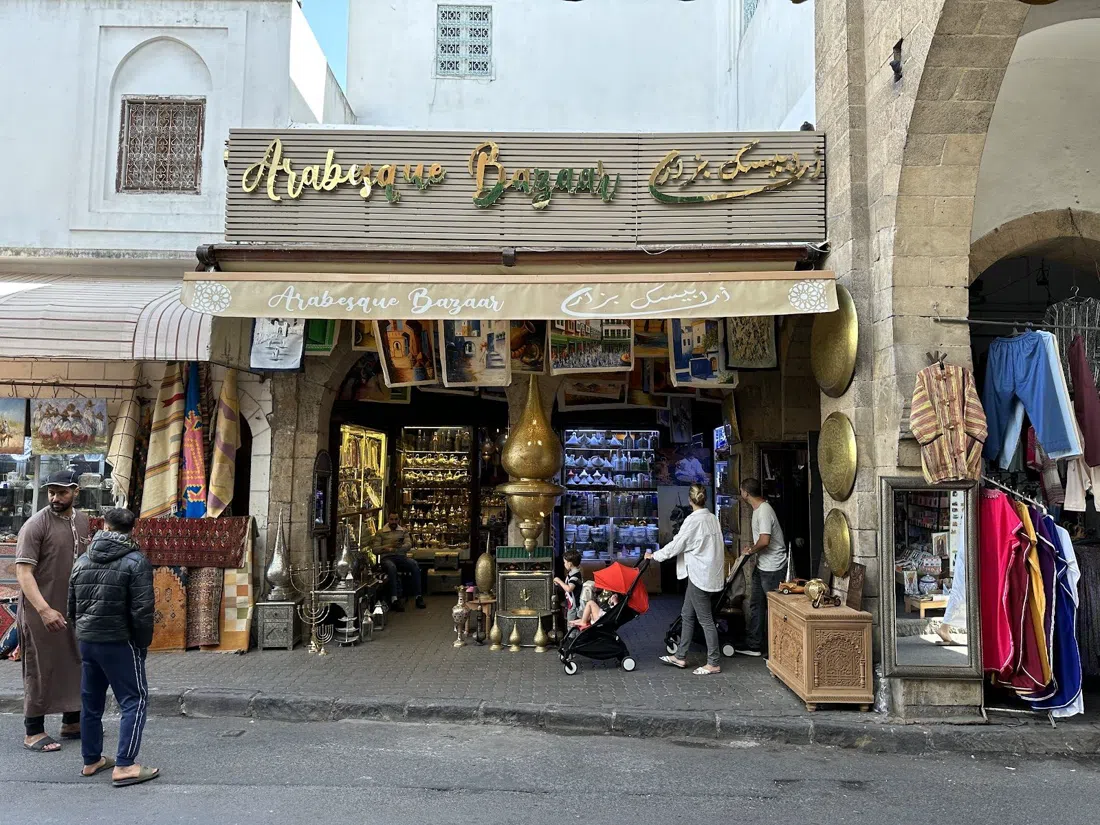
The Mahkama du Pacha stands in the same streets and has no ticket office. A guardian decides whether to let you in, and small groups do better than coachloads. Tip whoever opens the door 20 DH to 50 DH. Access is never guaranteed. Behind the doors are rooms of carved cedar ceilings, white stucco lacework and green-tiled roofs.
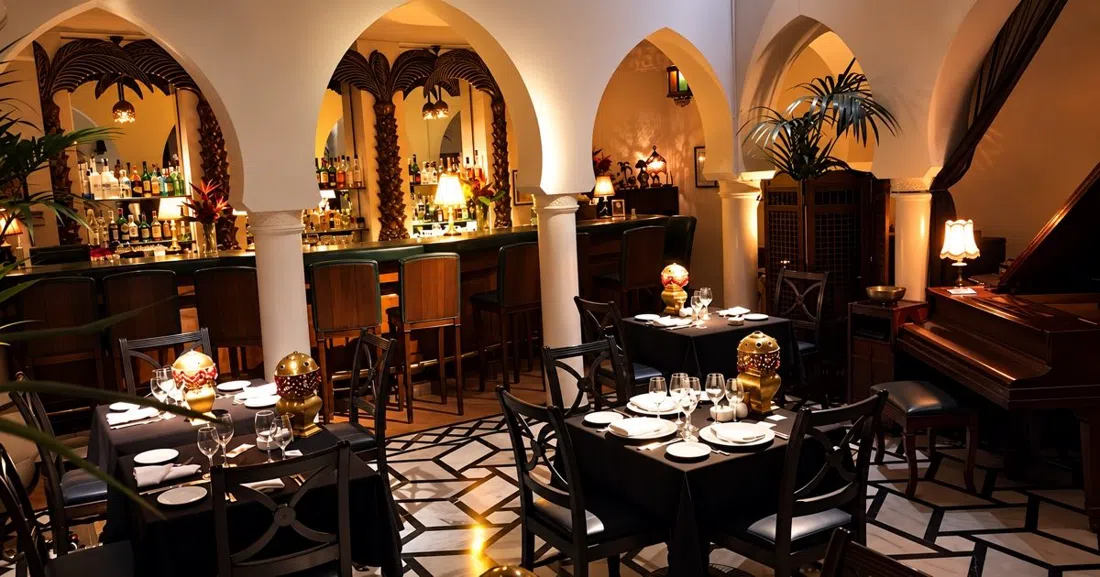
Rick's Café, near the old medina walls, is a courtyard bar in an old mansion: arched balconies, brass lanterns, potted palms and a grand piano under a curved staircase. It opens 365 days a year. Lunch runs 12:00 to 15:00, the first dinner seating 18:30 to 20:30 and the second 21:00 to 00:30, with live piano from 20:00. Reservations are effectively mandatory and a dress code applies; even booked guests queue at the door to be checked off the list. Tables are tight, the seatings are fixed, and a weekend table wants 48 hours' notice. Dinner is DHDHDH.
A Rabat morning above the Bou Regreg
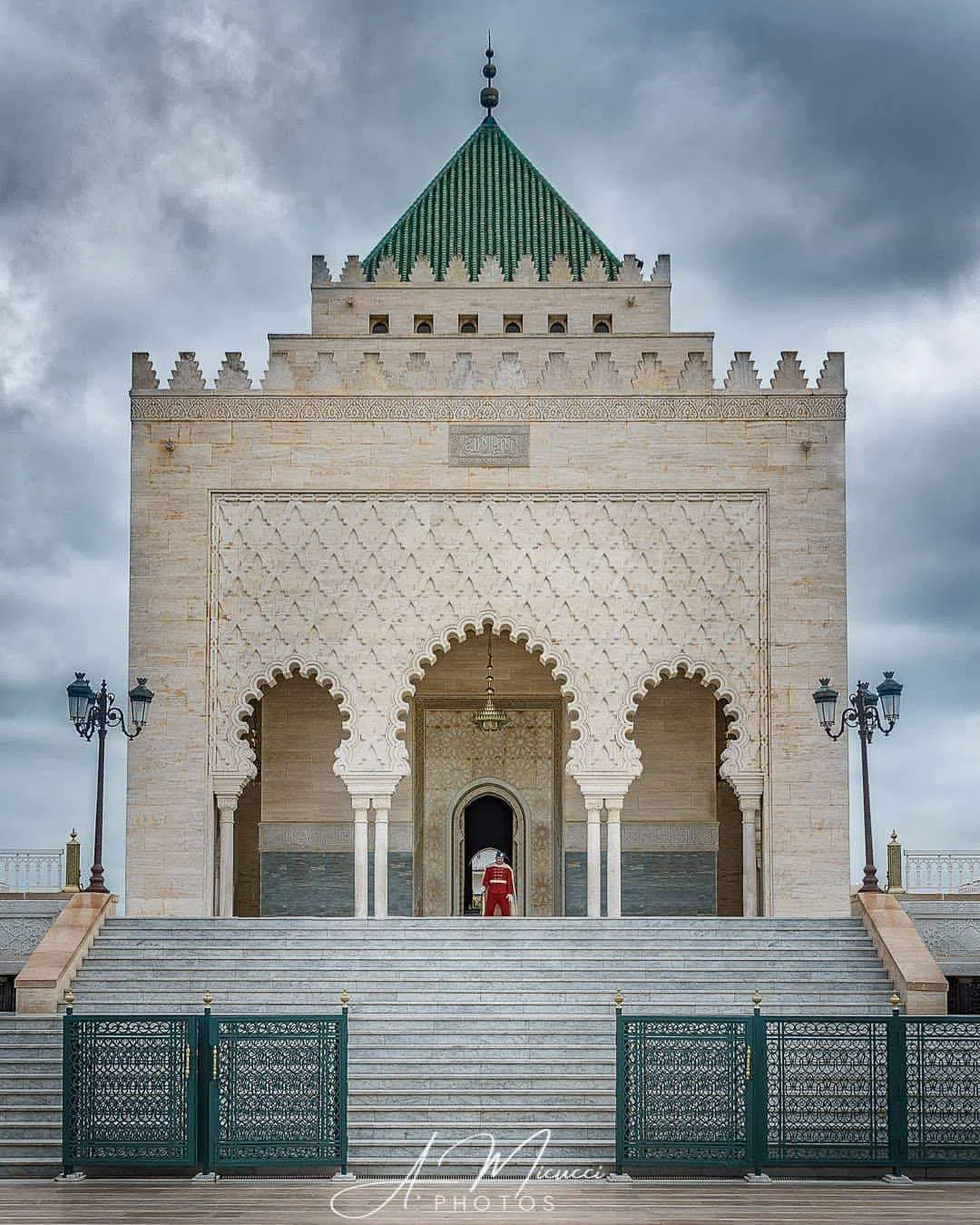
Hassan Tower and the Mausoleum of Mohammed V share one open esplanade, free and open daily to non-Muslims. The unfinished 12th-century ochre minaret stands over a field of several hundred broken stone columns. Opposite it, white marble under a green pyramid roof holds an onyx sarcophagus you look down on from a balcony, with royal guards in red capes at the doors. Cover shoulders and knees. This is a working royal tomb, and guides keep a group quiet and moving through it.
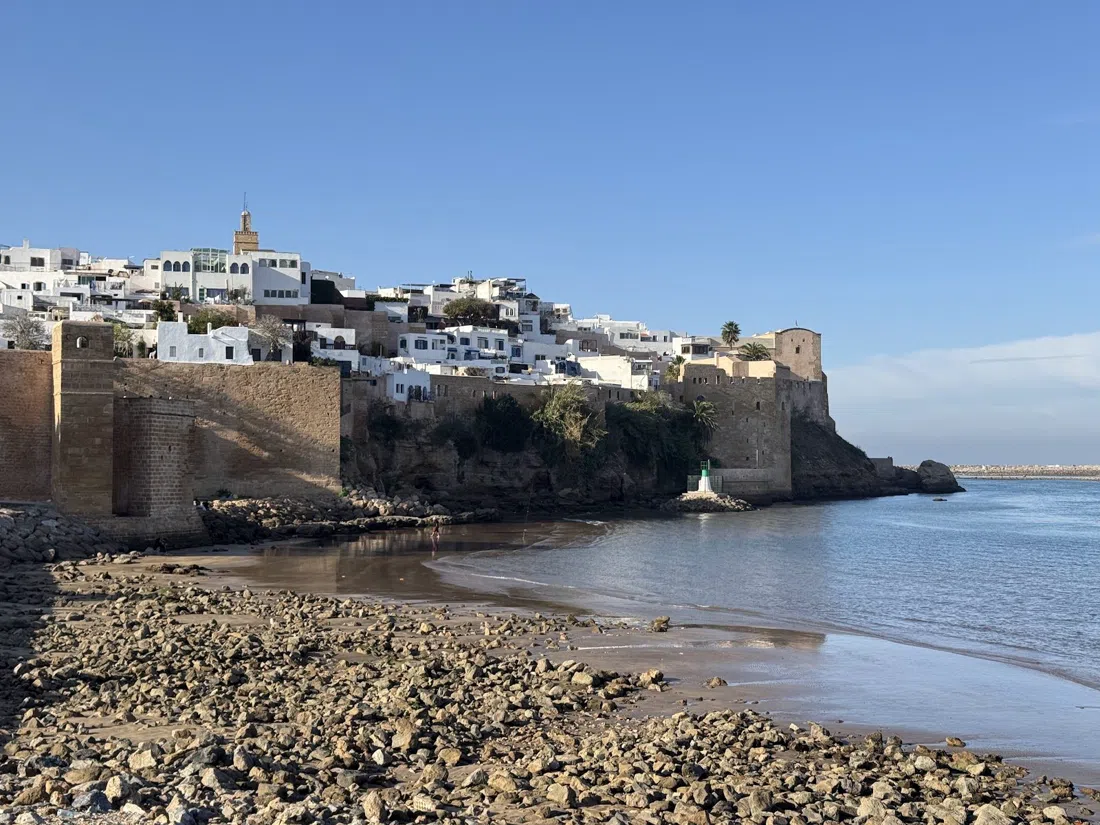
A 15-minute downhill walk brings you to the Kasbah of the Udayas, a 12th-century clifftop fortress above the mouth of the Bou Regreg. Entry is free and unticketed, the walled Andalusian garden included. Go in through the monumental Almohad gate, work along the blue-and-white painted lanes, and finish at the terrace café above the Atlantic surf, looking across to Salé. Those lanes are narrow and residential, and people live along them. The two stops pair naturally in one morning.
Volubilis and the granary at Meknes
Volubilis sits on the green farmland below Zerhoun, a hillside Roman city and a UNESCO site, where a triumphal arch and the basilica columns stand against open sky. Floor mosaics of Orpheus, Hercules and Bacchus lie uncovered in situ where the villas stood. Adults pay 70 DH and children under 12 pay 30 DH. Official guides wait at the entrance, from 150 DH for a group and 300 DH for a private tour. Allow two hours. There is almost no shade on the site.
At Heri es-Souani and the Royal Stables in Meknes, Moulay Ismail built a granary on cathedral-scale vaulted arches of mud brick, some of them now roofless and open to the sky, with a deep stone water basin alongside. The spaces are vast and there is no timed entry. Admission runs 10 DH to 70 DH depending on the gate, cash only, in small notes. The site opens 09:00 to 12:00 and 15:00 to 18:30, closing over the long midday break. Bab Mansour, the gate nearby, is admired from outside, since you cannot pass through it. Most itineraries rush this city.
The tannery terraces and the Al Batha museum
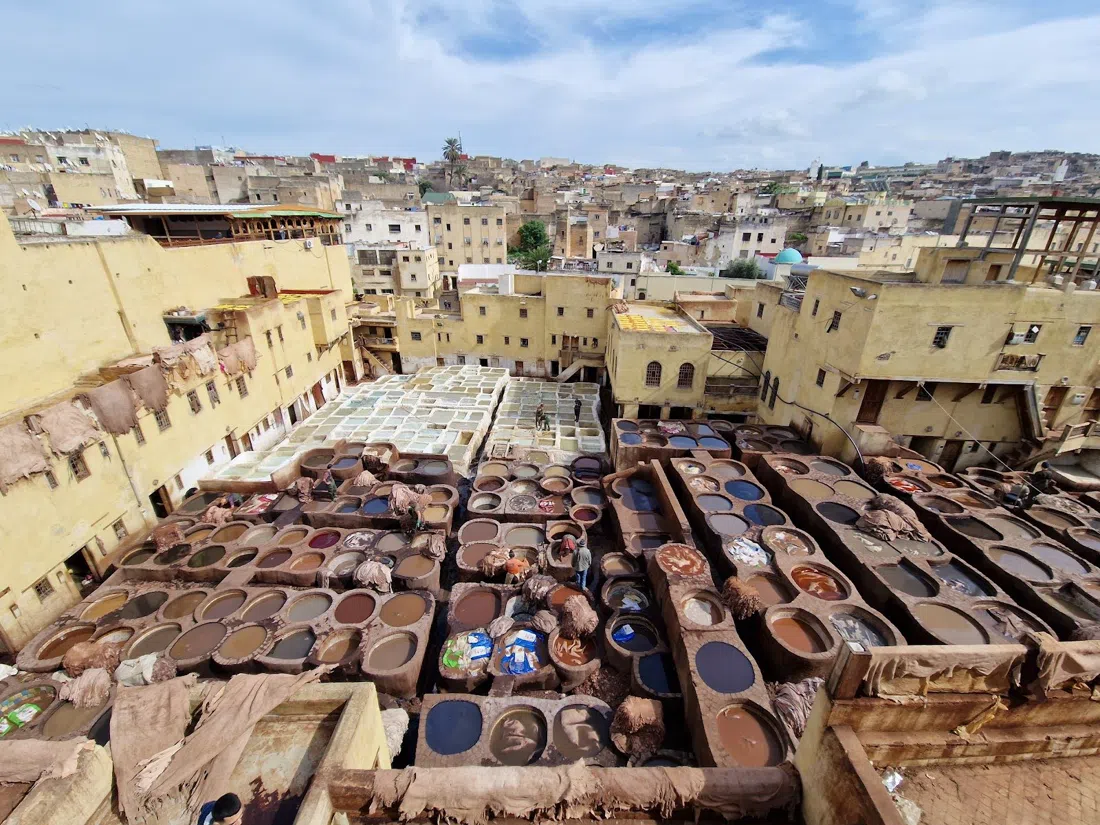
You look down on the Chouara Tannery from the terraces of the leather shops that ring the pits. Chalky white lime pits sit on one side; across the honeycomb of round stone vats the liquid glows saffron, poppy red, indigo and brown, and the hides dry on the surrounding rooftops. Nobody should charge you for the climb. The terraces belong to the shops and no ticket exists. Each terrace holds only a handful of people, so a group goes up in shifts. The pits have worked for a thousand years, the smell is strong, and the sprig of mint handed to you at the stairs does a real job. Browse the shop on the way down.
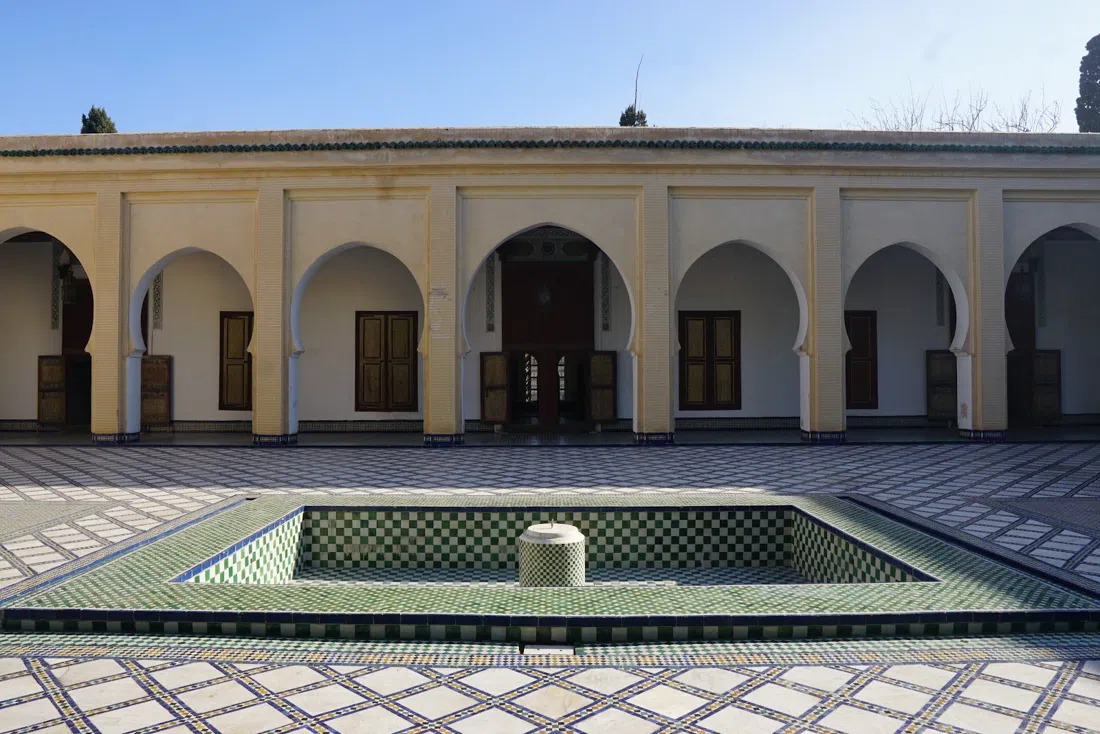
The Al Batha Museum of Islamic Arts, or Dar Batha, reopened on 26 February 2025 after six years of restoration, and that is the name to ask for now. The display runs dynasty by dynasty from the 8th century onward, much of it shown publicly for the first time, over a purpose-built circuit of 7,500 sq m. Blue-and-white Fassi ceramics, carved cedar panels and astrolabes sit behind glass in a 19th-century palace built around a sunken Andalusian garden of tall palms and orange trees. Admission is DHDH.
Chefchaouen's blue lanes
The medina of Chefchaouen stacks lime-blue houses up a steep slope under the twin Rif peaks, and the lanes climb steep and narrow. Both the medina and the Spanish Mosque viewpoint are free public space. The path to the mosque, a small abandoned 1920s building with a square stone minaret on the facing hill, is single file and takes 20 to 30 minutes. It ends looking down over the blue rooftops. Give the town an overnight.
Todra Gorge and a night on Erg Chebbi
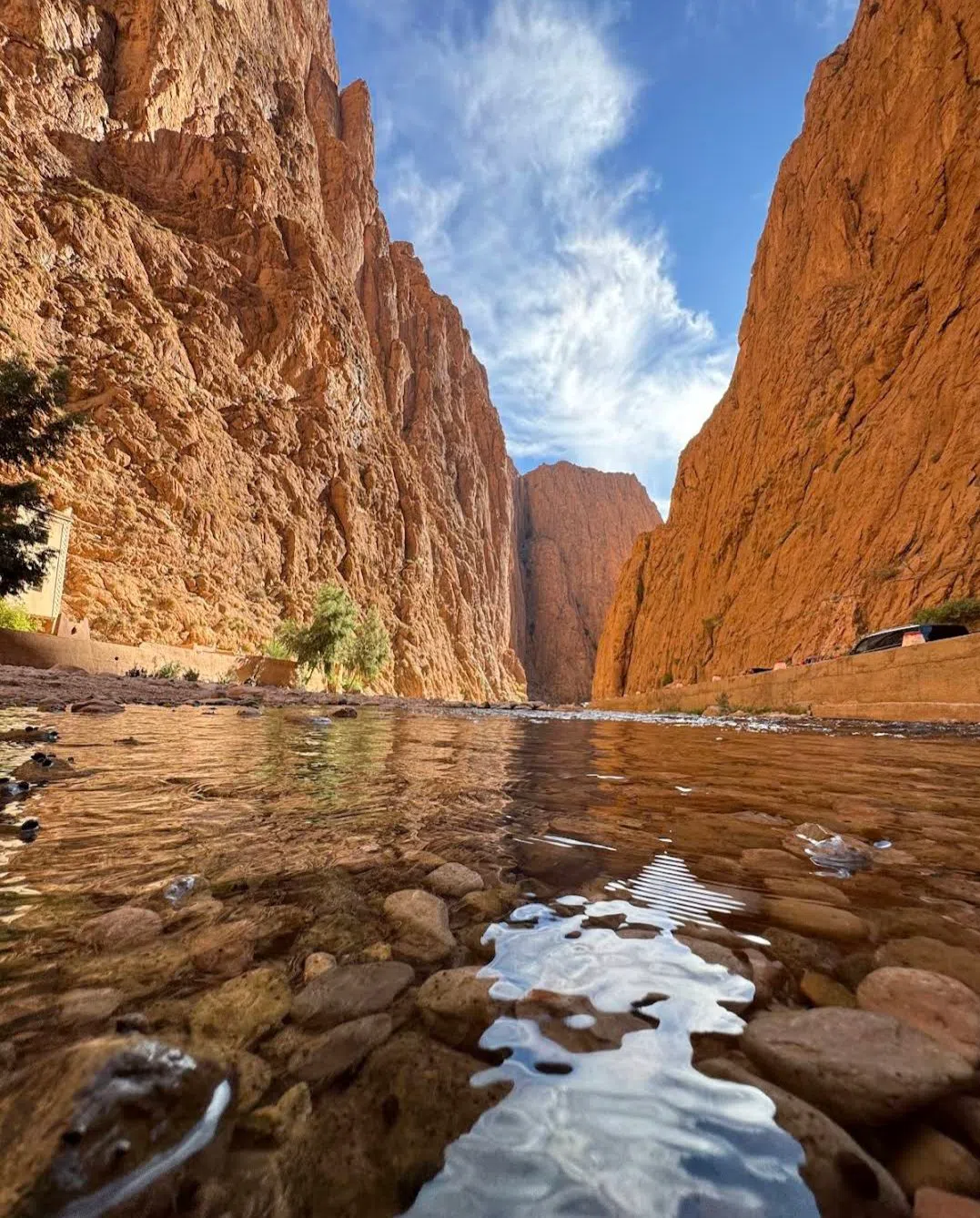
Todra Gorge lies 12 km to 15 km from Tinghir on good paved road, so you do not need a 4x4. Limestone walls up to 300m high close to a slot barely 10m wide, with a shallow stream and the road running along the canyon floor between them. A palm oasis and flat-roofed Berber villages sit at the mouth. Entry is free and a local guide starts at 150 DH. Walk the oasis rather than only driving through the canyon, which is the difference between a morning here and a photo stop. Climbing is done with certified local guides from Tinghir, booked a few days ahead, with guide and gear charged on top. The gorge is the breather between the Dades valley and the desert run.
Erg Chebbi, at Merzouga, is an orange Saharan dune field rising to 150m in sharp wind-carved crests, with black nomad tents pitched in a hollow between the dunes. A camel trek and one night in a luxury camp is DHDHDH. The camps are set up for groups, with private tents, a shared dinner and music round a fire. One night is the minimum that works, since sunset and sunrise are the hours to be out on the sand, when a camel train throws long shadows. This is the longest driving day of the loop.
Jemaa el-Fnaa, Bahia Palace and Jardin Majorelle
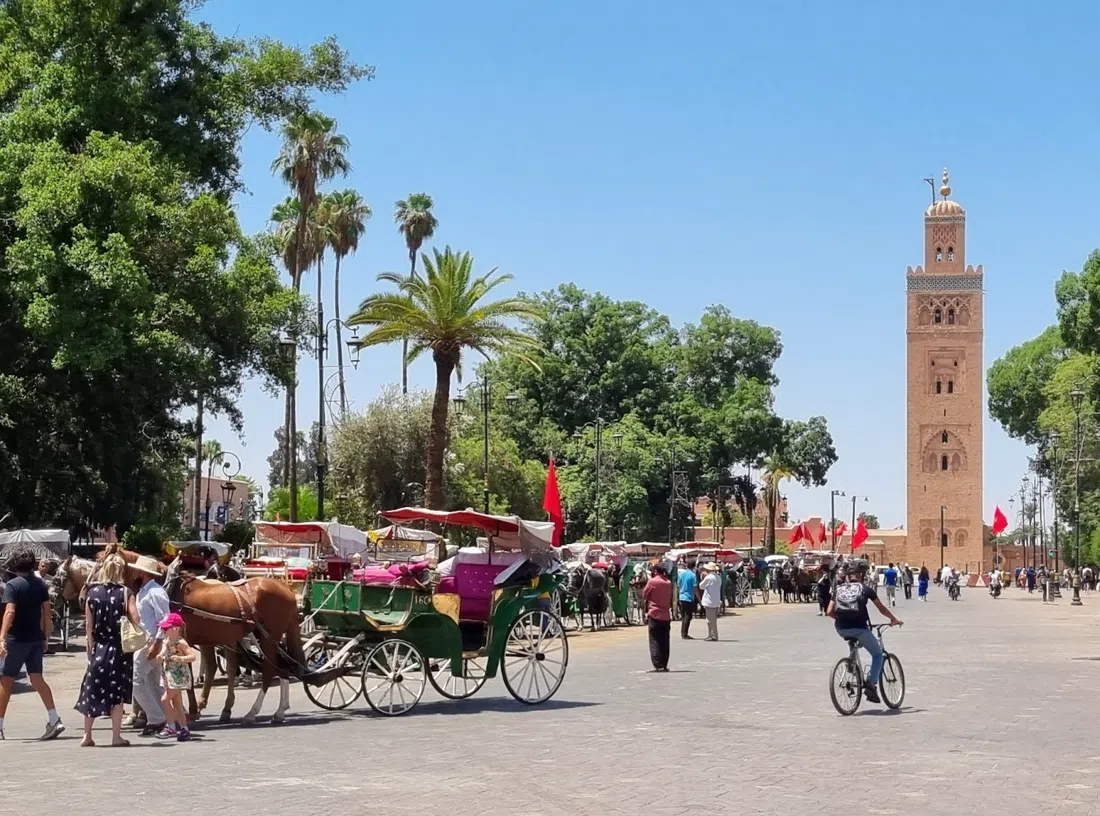
Jemaa el-Fnaa is a huge open square ringed by low terraces, free to enter, with rows of numbered food stalls under hanging bulbs and smoke, drum circles on the paving and the Koutoubia minaret lit behind. The stalls ladle harira and press orange juice. A 160-million-dirham requalification was in its final phase through 2026. It laid new natural cut stone underfoot, widened the halqa performance area and had the food stalls newly fabricated; the networks beneath were re-laid and the traffic around the edge reorganised. The square never shut for any of it, and hoardings still stand in places. Pickpockets and insistent performers work the crowd.
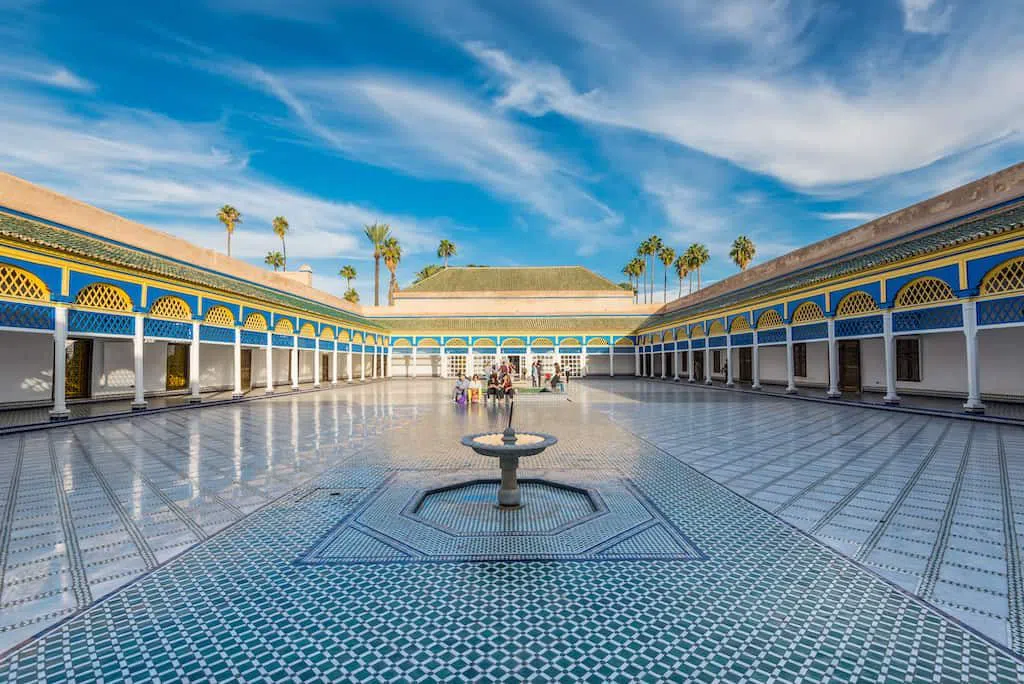
Bahia Palace opens daily 09:00 to 17:00, with last entry at 16:30 and shorter hours in Ramadan. Adults pay 70 DH to 100 DH. The 19th-century vizier's palace links courtyard to courtyard, from a vast marble court to painted and carved cedar ceilings, zellij dados in blue and gold, riad gardens of orange trees and empty harem apartments. The ceiling rooms bottleneck badly mid-morning. Expect scaffolding in a courtyard or two: the palace is on the post-earthquake restoration programme alongside El Badi and the Saadian Tombs, and it has stayed open throughout.
Jardin Majorelle sells tickets online only, through tickets.jardinmajorelle.com, and walk-ups cannot buy at the gate. The garden is 170 DH, 230 DH with the Pierre Bergé Museum of Berber Arts and 330 DH adding the Yves Saint Laurent museum. Entry is timed in 30-minute slots and numbers are capped, so a group has to be pre-booked and split across slots. The villa and its pergolas carry Majorelle blue against bamboo groves and towering cacti, with yellow planters, lily ponds and a shaded central walk. The garden runs 08:00 to 17:30, last entry 17:00, and the Berber arts museum 08:30 to 17:00. Villa Oasis closes Wednesdays.

Booking ahead and who the route suits
Een privéversie van deze route van acht dagen met een chauffeur-gids rijdt zeven dagen per week. Je betaalt voor het rijden en de volgorde van de dagen, want het woestijndeel kost rijuren enverschillende stops lopen op vaste dienstregelingen.
De route is geschikt voor een reiziger met acht vrije dagen die de Romeinse mozaïeken, de duinen en de blauwe medina op één lijn wil hebben. Er zijn vroege starts nodig en twee overnachtingen buiten de startstad. De toegang bij de meeste stops betaal je op de dag zelf aan de poort; het tijdslot voor de tuin en de tafel voor het diner in Casablanca regel je als eerste.
Beste tijd om te gaan
Volubilis opent om 08:00 en sluit van april tot september om 19:00, van oktober tot maart om 17:30. Ga bij de opening, want de hitte en de tourgroepen nemen beide snel toe na het middaguur. De Hassan II-moskee heeft tussen 15 maart en 15 september een extra vertrek om 16:00. In het hoogseizoen zijn de ochtendtijdslots bij Jardin Majorelle dagen van tevoren op. Late middag is het uur voor het mausoleum, wanneer de zuilen lange schaduwen werpen en het uitzicht over de rivier naar Salé het mooist is. In Chefchaouen is 07:00 tot 09:00 het enige venster met lege steegjes en zonder tourgroepen in beeld, en de klim naar het uitzichtpunt loont tijdens het gouden uur. Klimgidsen in Tinghir zijn in het voorjaar en de herfst snel volgeboekt.
Gesloten dagen en wat je moet boeken
Op vrijdag is het moskeeschema minder vol, Villa Oasis is op woensdag gesloten en het graanhuis sluit tijdens de lange middagpauze, dus stel het begin van elke dag af op wat voor jou geldt. Regel het tijdslot voor de tuin en de tafel voor het diner van tevoren, en neem kleine biljetten mee voor de poort die alleen contant geld aanneemt.
Bekijk de gids van Casablanca en de hotelzoekopdracht voor Casablanca.
Hotels in Casablanca
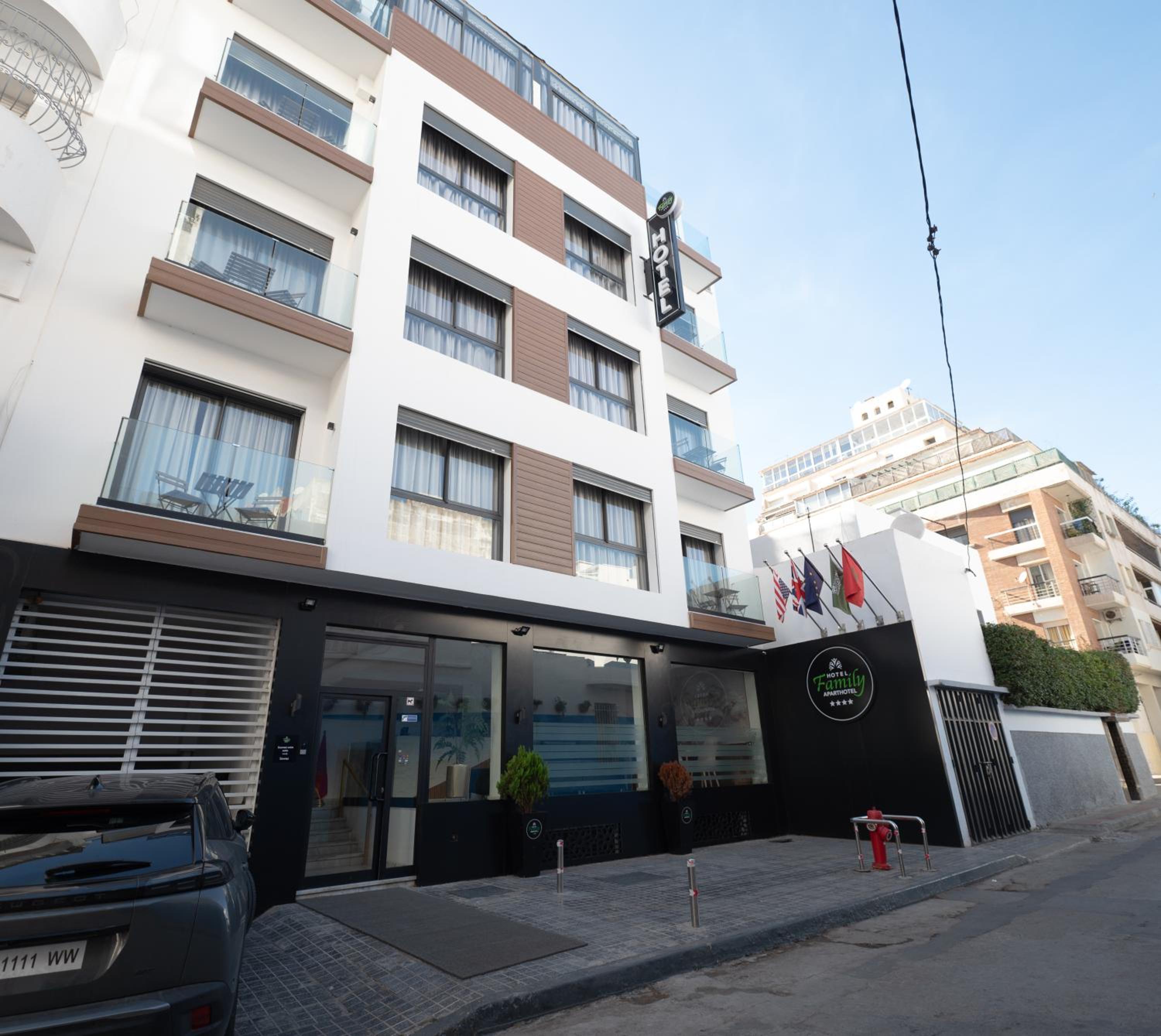
Family Aparthotel
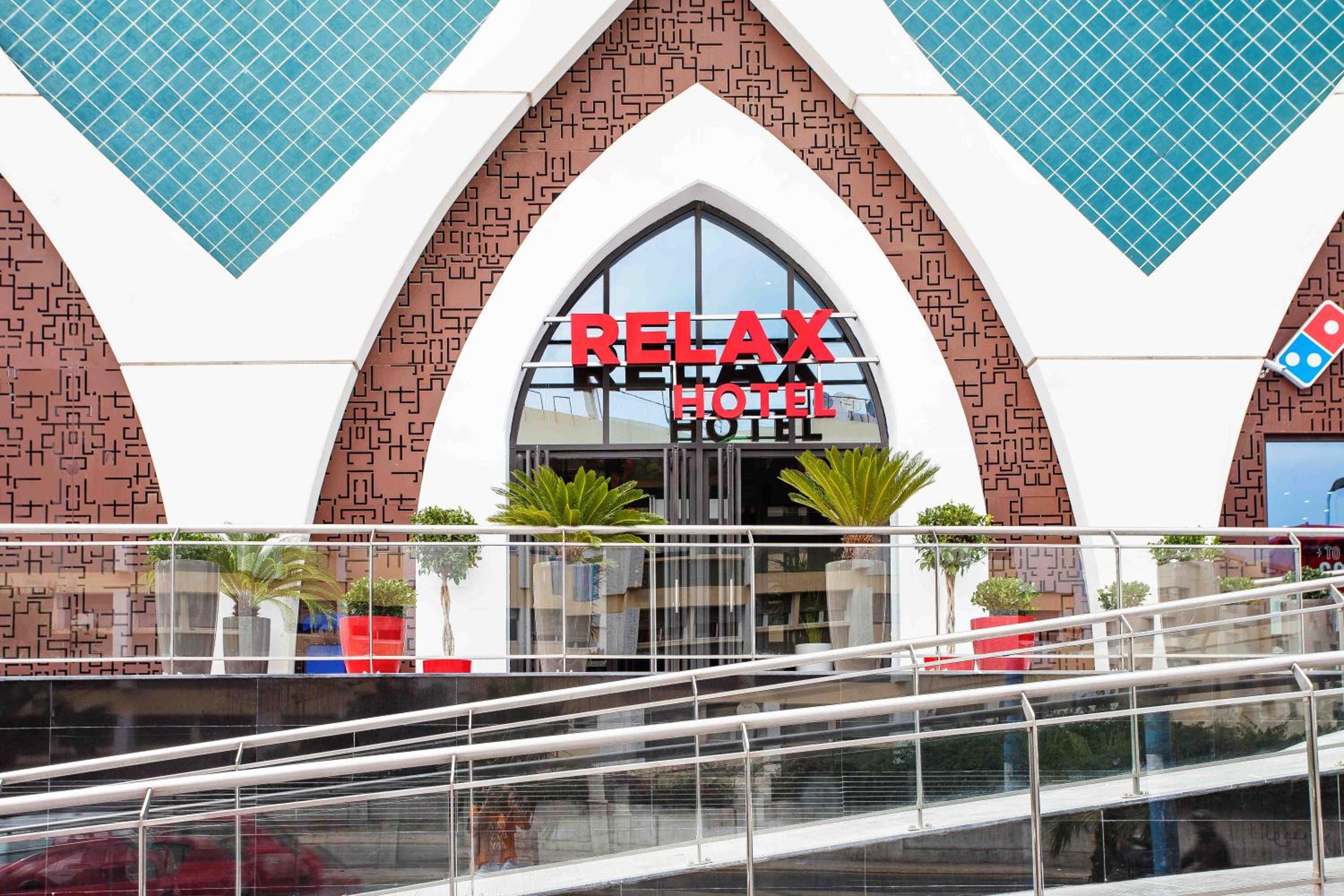
Relax Hotel Casa Voyageurs
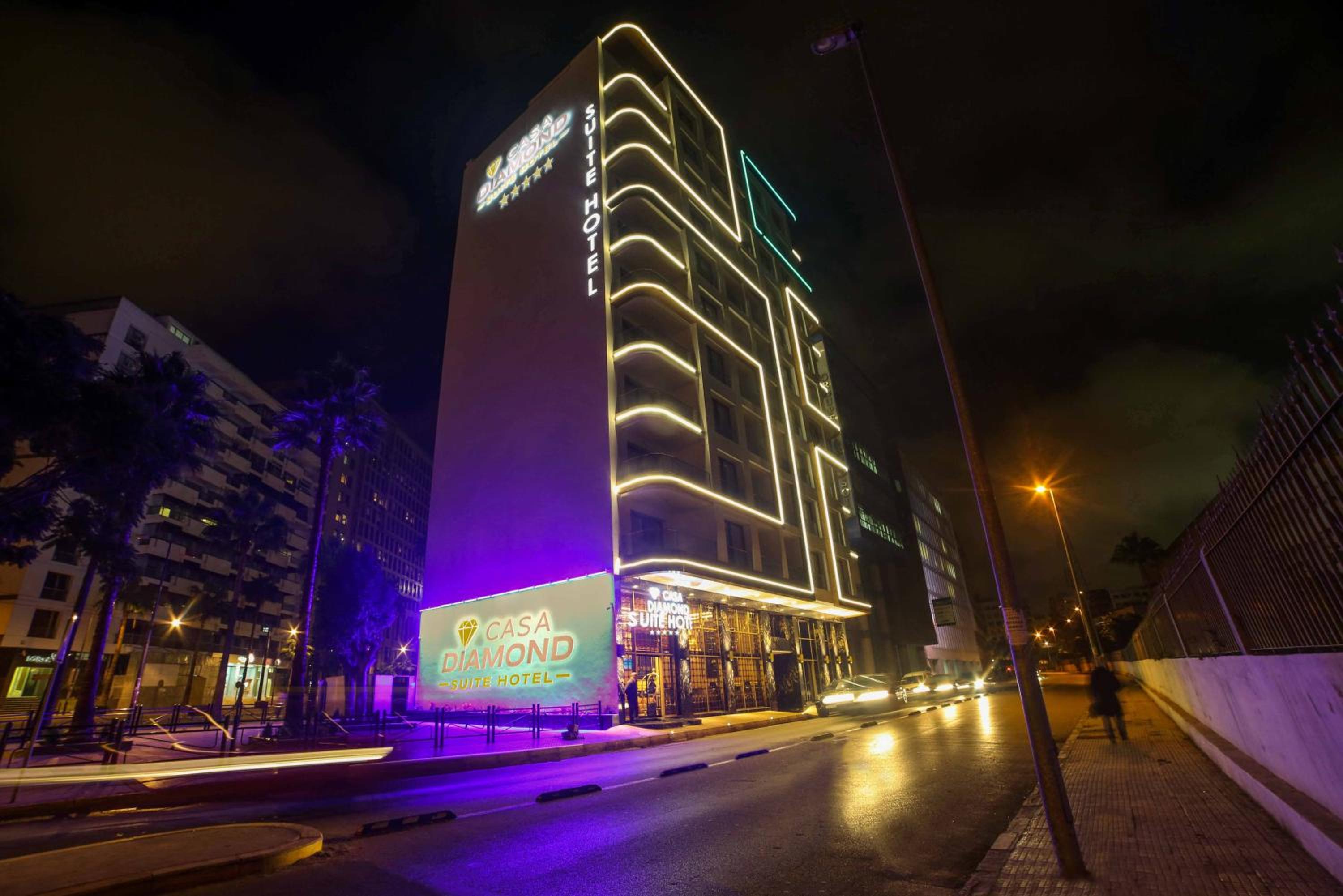
Suite Hotel Casa Diamond
Veelgestelde vragen
Mogen niet-moslims de Hassan II-moskee binnen?
Ja, alleen op de officiële begeleide rondleiding. Die duurt 45 tot 60 minuten en wordt gegeven in het Arabisch, Frans, Engels, Spaans en Italiaans. Rondleidingen vinden plaats van zaterdag tot en met donderdag om 09:00, 10:00, 11:00, 12:00 en 15:00, met een extra vertrek om 16:00 van 15 maart tot 15 september. Op vrijdag zijn er drie vertrekken, om 09:00, 10:00 en 15:00. Volwassenen betalen 140 DH, buitenlandse studenten 70 DH, kinderen van zes tot twaalf jaar betalen 30 DH en kinderen onder de zes jaar hebben gratis toegang.
Welke stops moet ik boeken voordat ik aankom?
Jardin Majorelle verkoopt kaartjes alleen online, via tickets.jardinmajorelle.com, in tijdsloten van 30 minuten; er is geen verkoop aan de poort, en de ochtendtijdslots zijn in het hoogseizoen dagen van tevoren op. Rick's Café zet je niet aan tafel zonder reservering, en een tafel in het weekend vraagt 48 uur van tevoren. Klimmen in de Todra-kloof betekent een gecertificeerde lokale gids uit Tinghir inhuren, een paar dagen van tevoren geboekt. Al het andere op de route betaal je aan de poort.
Waar heb je contant geld nodig, en hoeveel?
Heri es-Souani en de Koninklijke Stallen in Meknès werken alleen met contant geld, 10 DH tot 70 DH afhankelijk van de poort, dus neem kleine biljetten mee. De Mahkama du Pacha heeft geen kaartjesloket; de fooi voor de bewaker die hem opendoet is 20 DH tot 50 DH. De terrassen van de Chouara-leerlooierij zijn gratis en niemand mag je geld vragen om ze op te klimmen.
Hoeveel tijd heb je nodig in Volubilis, en is een gids de moeite waard?
Reken op twee uur. Volwassenen betalen 70 DH en kinderen onder de 12 jaar betalen 30 DH. Officiële gidsen wachten bij de ingang, vanaf 150 DH voor een groep en 300 DH voor een privérondleiding. De site opent om 08:00 en sluit van april tot september om 19:00, van oktober tot maart om 17:30. Ga bij de opening, want er is nauwelijks schaduw en zowel de hitte als de tourgroepen nemen na het middaguur snel toe.
Is één nacht in de woestijn genoeg?
Eén nacht is het minimum dat werkt in Erg Chebbi, want zonsondergang en zonsopgang zijn de uren waarop je het zeker de moeite waard vindt om op de duinen te zijn. Een kameeltocht met één nacht in een luxe kamp geeft je een privétent, een gedeeld diner en muziek rond een kampvuur. Reken ook op de weg: het woestijndeel is de langste rijdag van de route.
Geschreven door
Etienne Delmas
Reading Casablanca street by street
Etienne first came to Casablanca to catalogue its Art Deco and Mauresque facades and has spent fifteen years walking the centre-ville, Habous and Anfa on foot. He writes about the city's neighbourhoods, its architecture and the day trips out to the Hassan II Mosque and the coast.