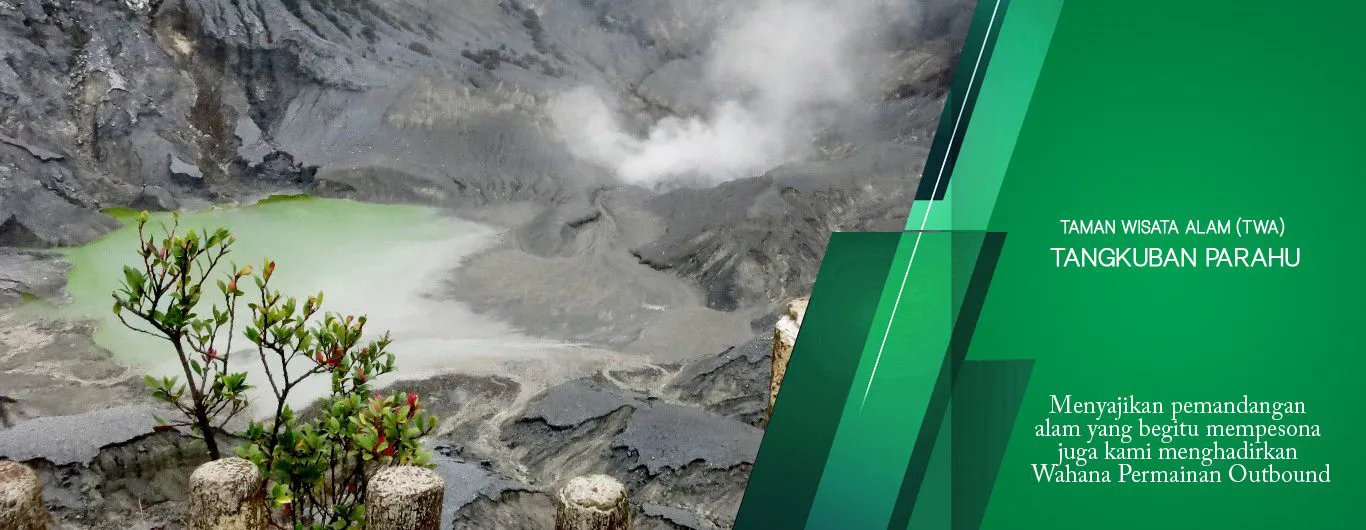
The summit road up Taman Wisata Alam Gunung Tangkuban Parahu (Kawah Ratu) ends in a car park beside the rim at 1,830m, where the ground drops into a grey-white bowl streaked with sulphur. Steam rises off the crater floor below the railing. PVMBG has held the alert level at Level I (Normal) through 2026.
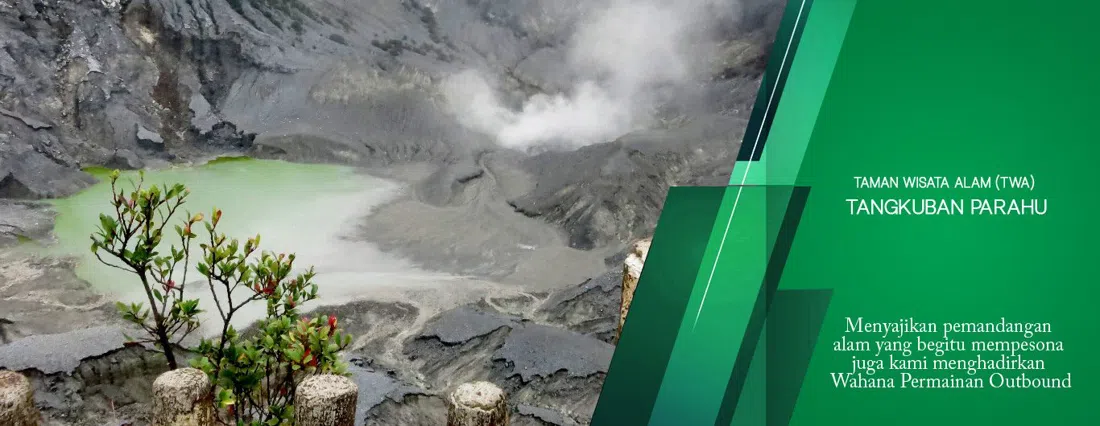
The rim at Kawah Ratu
This is the only drive-to active crater rim near Jakarta, and the day is built around it. Indonesian visitors pay Rp30,000 on a weekday, Rp40,000 at the weekend. The foreign rate is Rp200,000 on a weekday and Rp300,000 at the weekend, with a vehicle fee on top. Everything is paid at the gate.
The viewpoint asks nothing of your legs. The road finishes in a large bus and car park beside the rim, and groups walk straight out to the railing. Souvenir stalls and pine trees crowd the earth rim behind you.
PVMBG warns of sudden phreatic blasts, and the rim can shut at short notice. Check the mountain's status the morning you go.
The walk down to Kawah Domas
Kawah Domas is the half of the volcano most day trips leave out. A 1.2km forest trail drops to a bare ochre and grey hollow of bubbling mud pools and hissing vents, 30 to 40 minutes each way.
The field is guided only, one guide to between one and six guests, so a larger party splits into several guided groups. The guide is Rp100,000 for up to six people, and the field itself sits inside the park ticket you already hold. Eggs are lowered into the boiling water in bamboo baskets for a small extra charge, as is the sulphur mud spa, which leaves people smeared pale against the forest wall.
Wear shoes you don't mind ruining. Wear shorts if you want the mud.
Tea rows at Ciater
Kebun Teh Ciater (Ciater Tea Plantation & Tea Factory) lies at the foot of the volcano, waist-high bushes in tight green rows rolling over the Subang hillsides under the cone. A raised wooden walkway carries you out over the crop. PTPN runs the estate for visitors and takes tour groups daily, factory walk-throughs included, and the withering troughs stand inside the Dutch-era sheds.
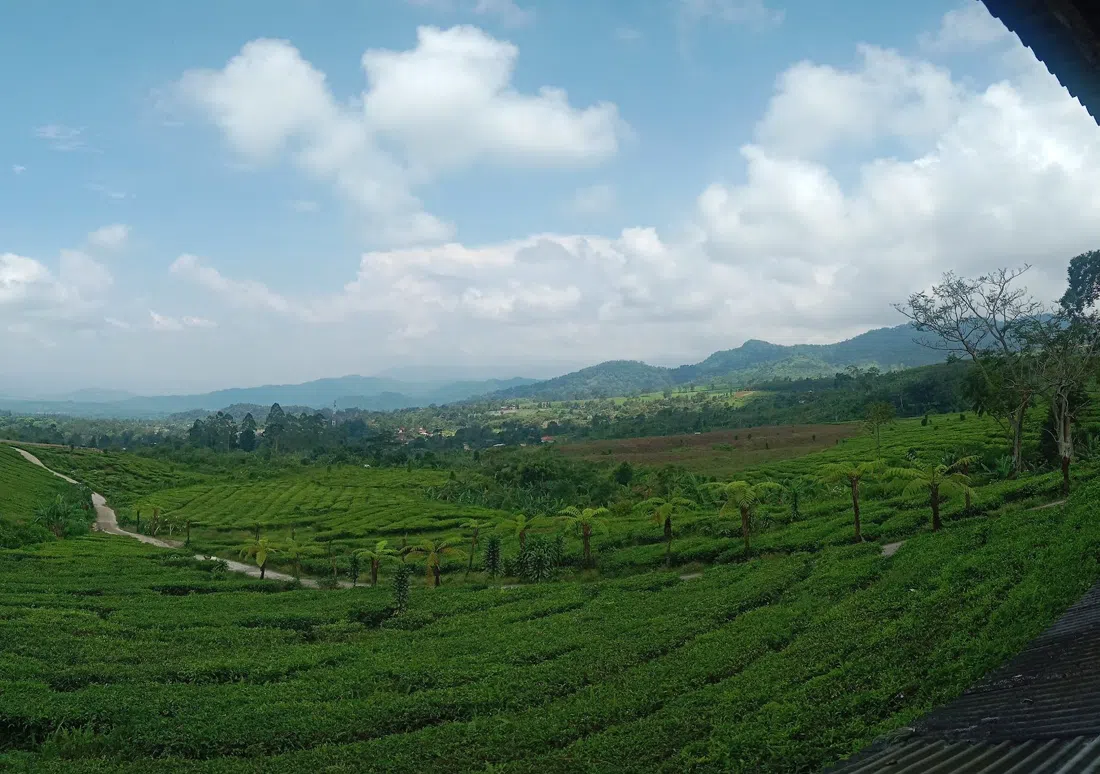
Entry to the plantation area is Rp5,000. Tea walks and factory visits are priced separately, and cafe drinks are extra.
游览 Kawah Domas 需要导游吗?步行要走多久?
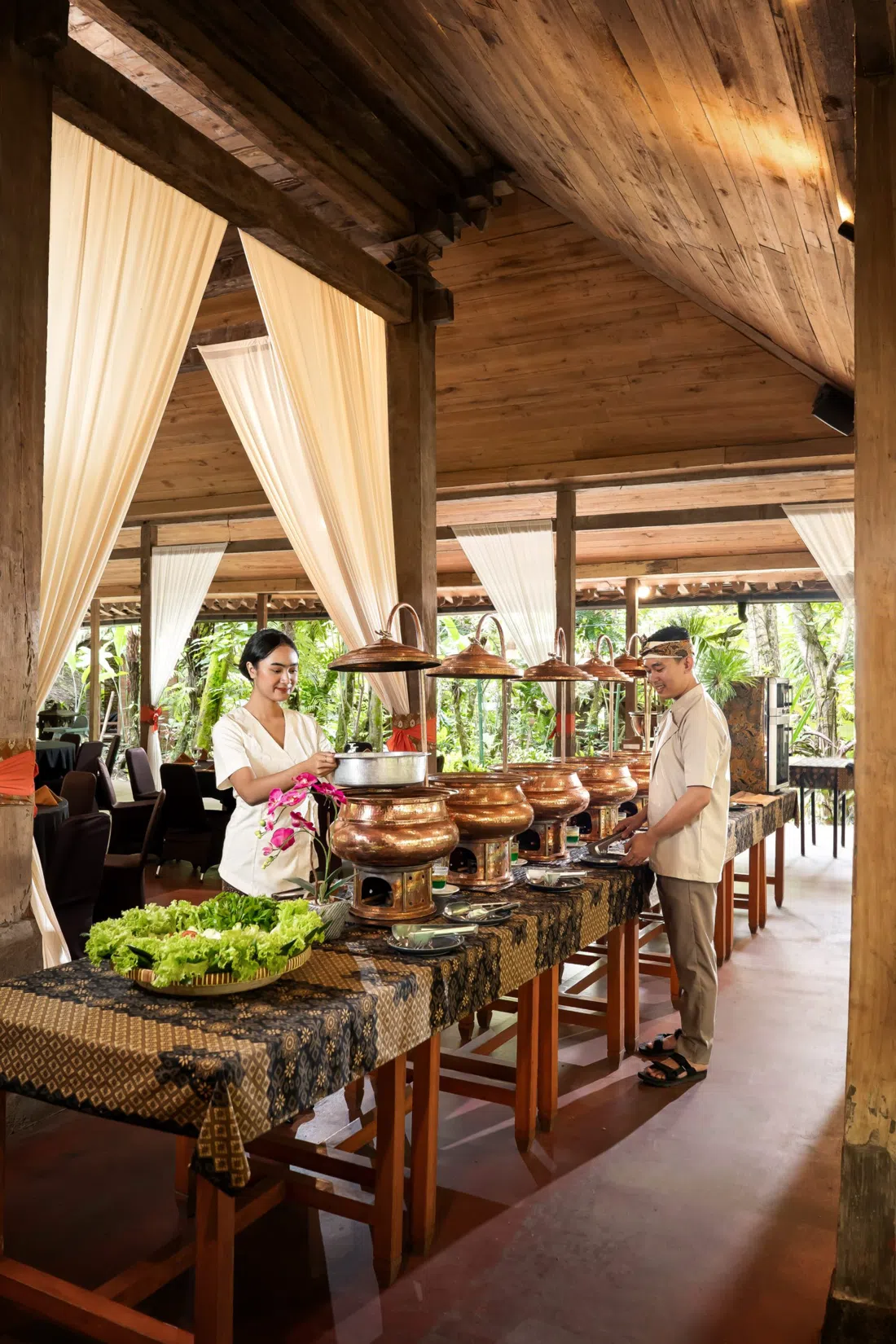
Kampung Daun Culture Gallery & Café is the better-known alternative, a wooded ravine of open-sided thatched huts terraced down beside a stream, lanterns strung through the bamboo and small waterfalls between the dining decks. The kitchen is strong on nasi liwet. Mains are Rp40,000 to Rp150,000, and some huts carry a minimum spend. It has taken group bookings since 1999 and opens 09:00 to 21:00.
Fruit at Pasar Panorama and La Fresa Farm
Pasar Panorama Lembang is the market behind the fruit-market line on these itineraries. Tarpaulin-shaded stalls hold highland strawberries, avocados and salak, weighed on hanging scales over narrow wet aisles. Produce sells by the kilo, and a bag of strawberries or avocados costs single-digit to low tens of thousands of rupiah.
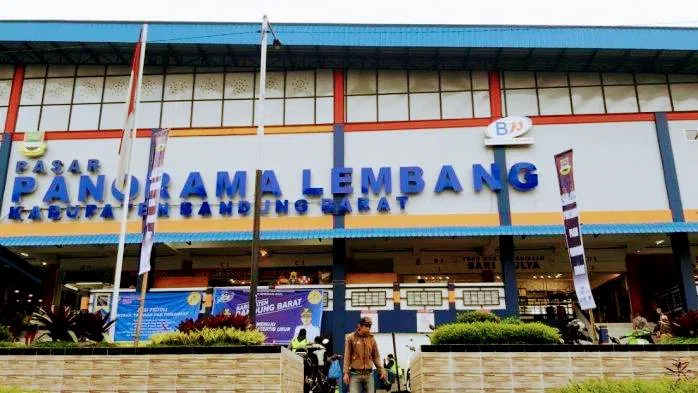
Go early. This is a working public market with no door policy, and the aisles are tight, so a big group should go in in twos and threes. The market was renovated and some traders moved to the newer Modern Market on Jalan Raya Lembang. Stalls shift about.
La Fresa Farm Lembang is the most reliable fruit-picking stop in Lembang. Long polytunnel greenhouses hold raised strawberry troughs at chest height, big pale Japanese berries on the vine, with the Jayagiri hills outside. Scissors and baskets are provided. The farm is set up for school and tour groups, with outbound activity space beside the picking.
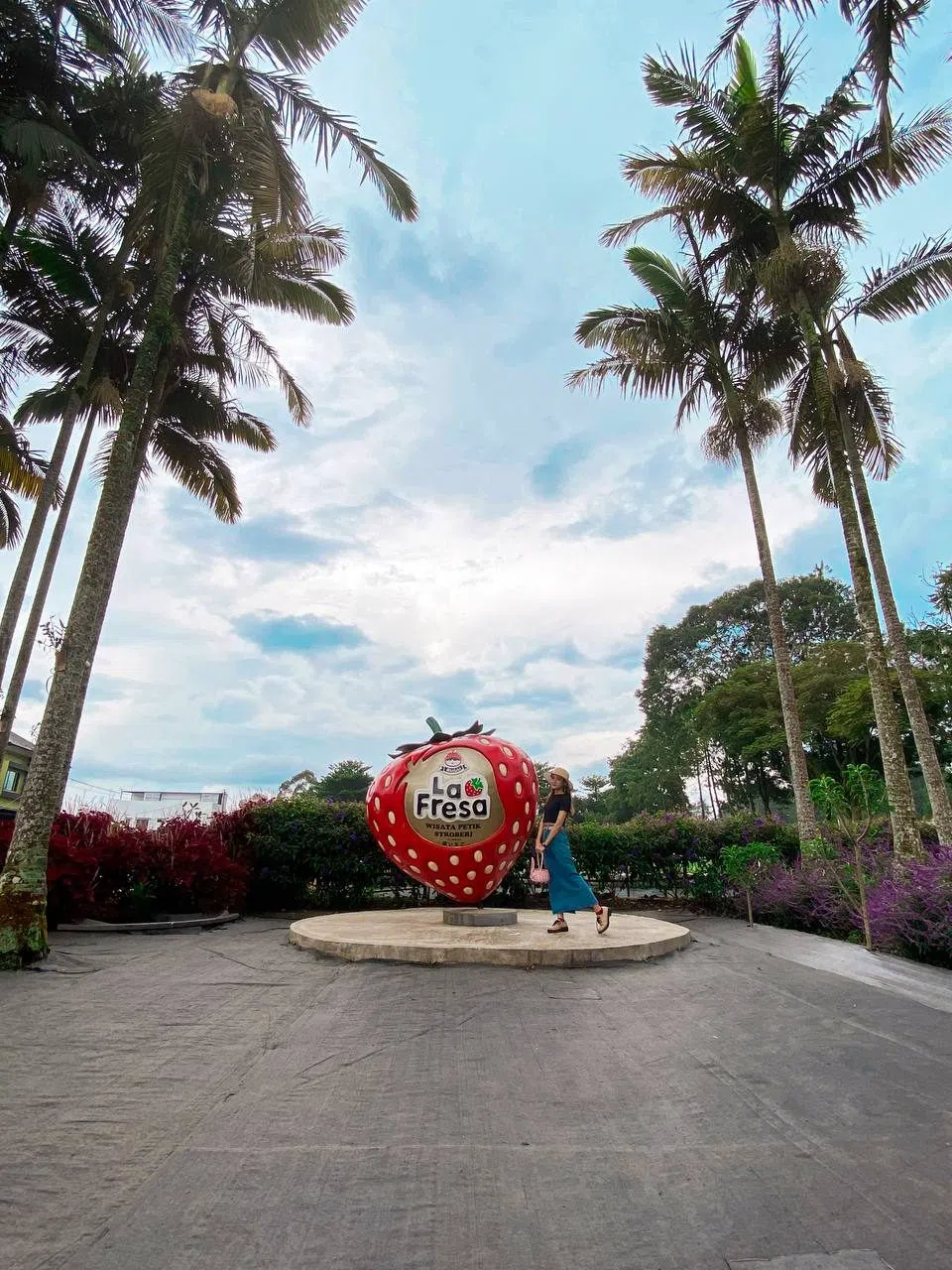
Entry is Rp35,000, redeemable against a strawberry product. Berries are Rp25,000 per ounce, and you pay by weight for what you take home. The farm opens 08:00 to 17:00 daily.
Extra stops on the Lembang road
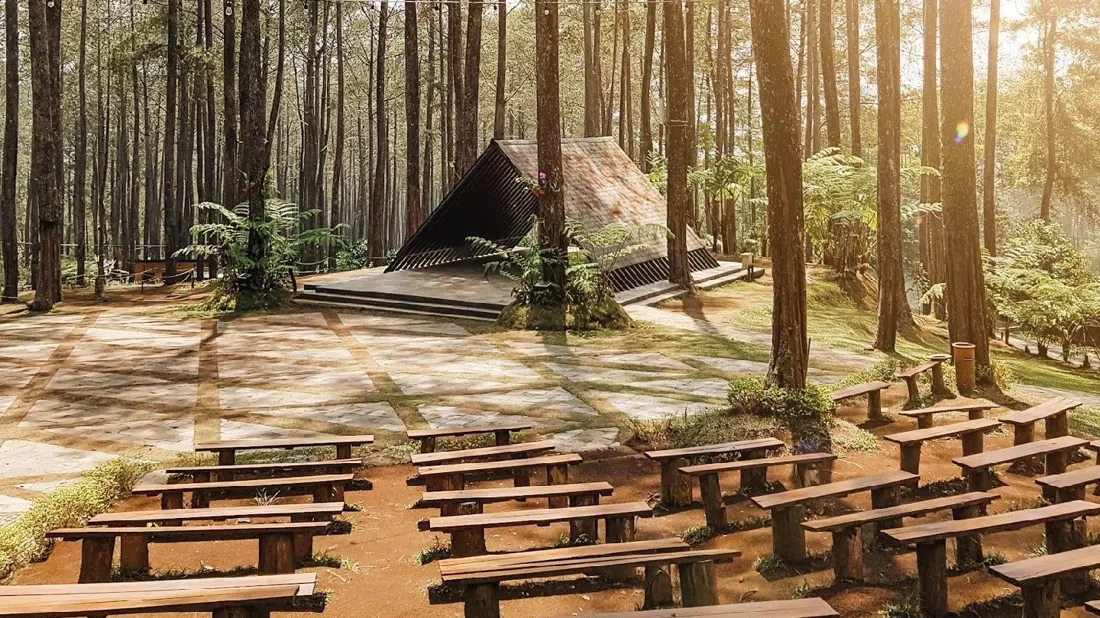
Orchid Forest Cikole (Lembang-Tangkuban road) sits directly on the road up to the crater, which makes it the cheapest extra to bolt on. Orchids are mounted on tall straight pine trunks, and a 125m rope-and-plank sky bridge hangs 23m up between the trees. The bridge is single file, and a group crosses in a stagger. Tickets are Rp50,000 to Rp55,000 on a weekday. Weekend entry is Rp60,000 to Rp70,000. All-access is Rp125,000 and the sky bridge Rp20,000 extra. The gate opens at 10:00, after you should already be at the volcano.
Farmhouse Lembang is five minutes from the Lembang junction, a mock-Alpine run of timber and stone buildings with a round-doored hobbit house built into a grass bank and deer and rabbit pens behind. It is a photo park. Entry is Rp35,000, swappable for a bottle of Lembang milk, and that swap is well liked. Weekends and holidays run Rp40,000 to Rp50,000. The hobbit slide is Rp25,000 and rented Dutch costumes Rp85,000 to Rp135,000. It opens 09:00 to 18:00, with coach parking and costume desks on site.
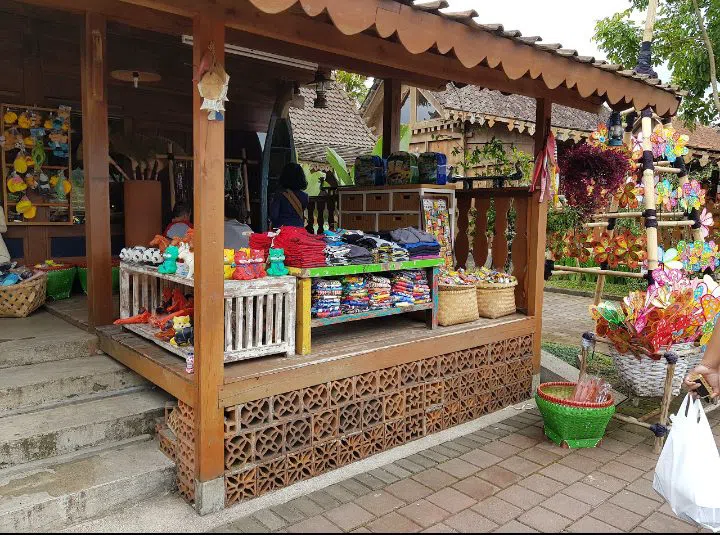
Floating Market Lembang still trades daily, wooden sampans moored along the lake edge serving food straight from the boats, swan pedal boats and a Japanese-style garden behind. You buy wooden tokens first, since the stalls take no cash. Entry is Rp40,000 as of October 2026. Boat rides are Rp25,000 to Rp35,000 per person, and a cruise is Rp100,000 to Rp200,000 per boat. Hours run 09:00 to 18:00 on weekdays and later at weekends.
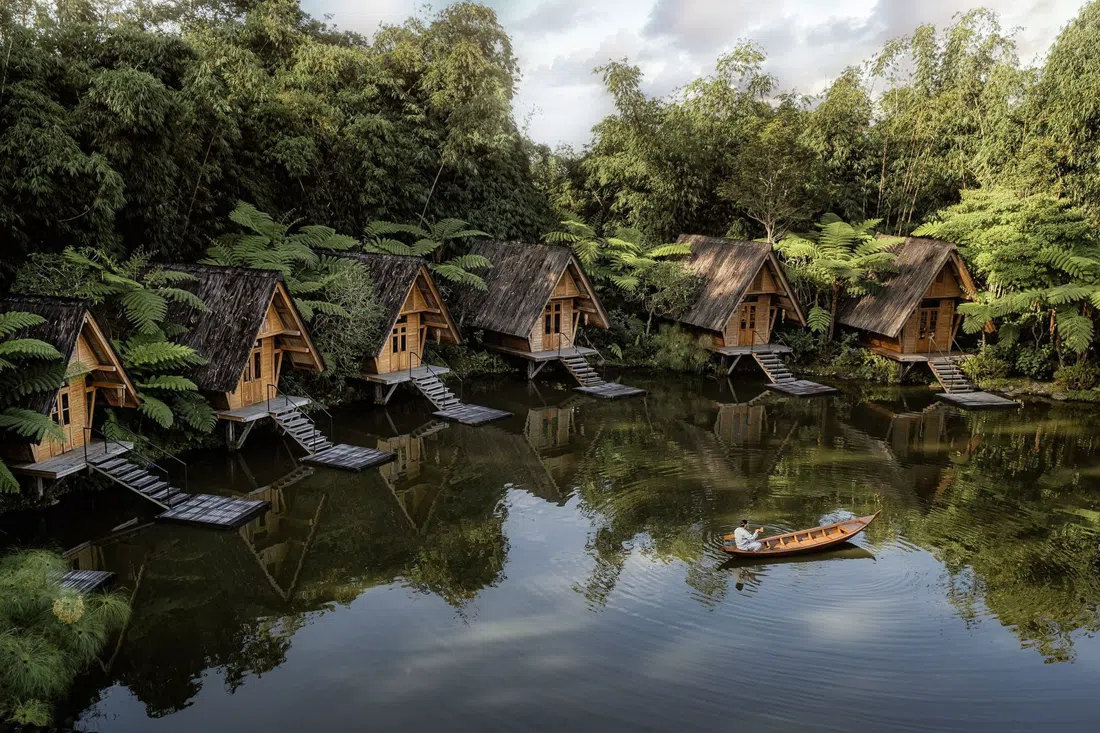
Dusun Bambu Family Leisure Park is the most scenic place around Lembang to feed a large group, 15 hectares of terraced lawns and bamboo walkways above a small lake with paddle boats and Mount Burangrang behind. The giant woven-bamboo nest pods in the trees are the image people come for, and four themed restaurants absorb the volume. Entry is Rp25,000 on a weekday, Rp30,000 at the weekend. Peak days are Rp40,000. Activities are ticketed one at a time at Rp35,000 to Rp90,000. The grounds open 09:00 to 21:00 and the rides 10:00 to 17:30.
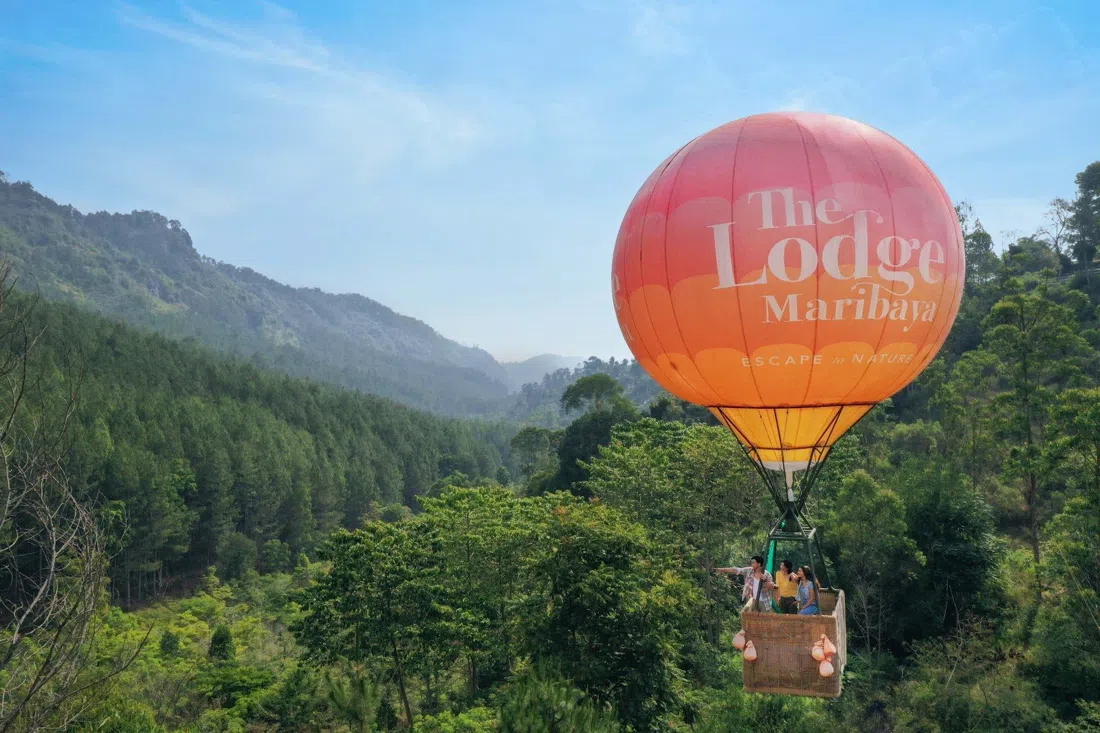
The Lodge Maribaya is the photo stop on the Maribaya side, a pine ridge with a swing and a hammock cantilevered out over the valley drop, a tethered hot-air-balloon basket and bamboo sky platforms in the mist. Entry is Rp65,000 basic, up to Rp145,000 to Rp165,000 for all-access. Individual rides are Rp11,000 to Rp35,000, and each one queues separately. The park opens 09:00 to 17:00. Come only if your group wants the rides, since an hour here is an hour off the volcano.
Museum Geologi Bandung on Jalan Diponegoro
Museum Geologi Bandung (Jalan Diponegoro) explains what you stood on at the rim. Four galleries cover Indonesian geology, hazards and the history of life, and mounted dinosaur and mammoth skeletons stand under the high ceiling of the 1928 colonial hall. Java Man hominid skulls and West Java volcano models sit in glass cases.

普通游客门票 Rp3,000,学生 Rp2,000。外国游客需付 Rp10,000。博物馆周一至周四 09:00 至 15:00 开放,周末 09:00 至 14:00 开放,周五闭馆。散客在门口扫描二维码入场。人数超过 20 人的团体须提前一个月通过 WhatsApp 预约。
提前预订与现场付费
本路线上的每个景点都是抵达后现场购票,有导游的一日游每周七天都有发团。有两件事不能留到现场:周末在 Sapu Lidi 订位,以及人数超过 20 人的团体参观博物馆。若干门票在工作日比周末便宜,而周末也正是午餐餐厅最满的时候。
一整天值得吗
火山口和 Kawah Domas 步道是这一天的重头戏,茶园、温泉和午餐则填满了两地之间的车程。它适合只有一天空闲、想近距离看活火山又不想凌晨爬山的旅行者;不过需要早出发,也需要耐心应对那些为大巴车流量而设计的园区。
最佳出行时间
请在莱姆邦路沿线的园区开门之前就到达火山口边缘开始游览。火山口是唯一可能在你抵达当天关闭的景点,所以先去。
如果你在意水果市场,可以把 Pasar Panorama 安排在登山之前,那时摊位最为热闹。Kawah Domas 留到上午晚些时候,这时你已看过火山口边缘,也不怕弄脏衣服。温泉放在最后,Sari Ater 会营业到夜里。
选择工作日出行。火山口园区、Asstro Highlands 和 Dusun Bambu 的周末票价更高,而周五则完全无法参观博物馆。
出发前
出行当天早上请查看火山状态,因为火山口边缘可能会突然关闭;同时记住博物馆周五不开放。周末午餐订位以及人数超过 20 人的团体请提前预订,其余费用均在抵达后现场支付。
Jakarta的酒店
常见问题
进入 Tangkuban Parahu 火山口景区需要多少钱?
印尼游客工作日票价 Rp30,000,周末 Rp40,000。外国游客工作日 Rp200,000,周末 Rp300,000,另加车辆费用。票款在门口现场支付。
我到达时火山口可能已关闭吗?
需要。PVMBG 在 2026 年全年将警戒级别维持在 I 级(正常),但它警告可能发生突发的喷气式爆发,火山口边缘可能会临时关闭。出行当天早上请查看火山状态。
游览 Kawah Domas 需要导游吗?步行要走多久?
Kawah Domas 只提供有导游陪同的游览,每位导游带 1 至 6 位游客,因此人数较多的团体会分成几组。导游费为 Rp100,000,最多可带六人,园区门票涵盖火山地带本身。步道全长 1.2 公里,单程需 30 至 40 分钟。
泡温泉选 Sari Ater 还是 Maribaya?
大多数人会在 Sari Ater 停留,该地大多数日子 08:00 至 22:00 营业:园区套票 Rp50,000 至 Rp55,000,泳池套票 Rp90,000 至 Rp95,000。当 Sari Ater 人满为患时,Maribaya 会清静许多,门票 Rp35,000 至 Rp45,000,不过它位于峡谷之中,台阶很多。
20 人或以上的团体应该在哪里用餐和参观?
Sapu Lidi 的大型 saung 小屋可供团体以 lesehan 席地方式就餐,因此周末请提前订位;Kampung Daun 自 1999 年起就接受团体预订。人数超过 20 人的团队参观 Museum Geologi Bandung 需提前一个月通过 WhatsApp 预约。
作者
Tomé Soares
The city read on foot, one kampung at a time
Raised between Lisbon and Jakarta, Tomé walks Kota Tua's colonial squares and the Menteng backstreets to work out how the city's neighbourhoods actually connect. They pair a National Museum morning with a canal-side kopi and will say plainly when a sight is worth the traffic and when it isn't.