At six in the evening the counters along Calle de la Victoria start to steam, and you smell the garlic from the corner before you see the door. Puerta del Sol itself takes four minutes: a kilometre-zero plaque underfoot, a clock tower that owns New Year's Eve, a bronze bear most people photograph from the wrong side. The reason to stand here in October is the half-kilometre of bars around it, where a pan of prawns costs less than a museum ticket and the evening only gets going at an hour most visitors have already eaten.
What tapas hour actually is around Sol
Tapas hour is not an event anyone organises. It is the gap Madrid leaves between a lunch that ends at four and a dinner that starts at half nine, and around Sol it fills roughly between 7.30pm and 9.30pm midweek, earlier and far messier at weekends. Almost nobody sits. You stand at a counter, order one thing and a drink, pay, then walk two streets to the next place. That is why the advice below is mostly about doors, capacity and timing rather than menus.
Three things before you start. First, the price chalked up is usually the counter price; a table, and especially a terrace table, can cost more at the same address, and in October the terraces are still in play, so that difference is live. Second, the free-tapa-with-a-drink custom is weaker here than visitors expect. Around Sol you order and pay for what you eat, and that is fine, because what you are paying for is one thing done for a century. Third, the bar keeps your tab in chalk or in its head and you settle at the end; trying to pay per round confuses everyone, including you.
Everything in this article sits inside a twelve-minute walk of the square, which is the entire argument for eating here instead of trekking out to a district you have to research first. For how the rest of the city fits together, the Madrid guide is the better starting point.
Garlic prawns in the pan they were cooked in
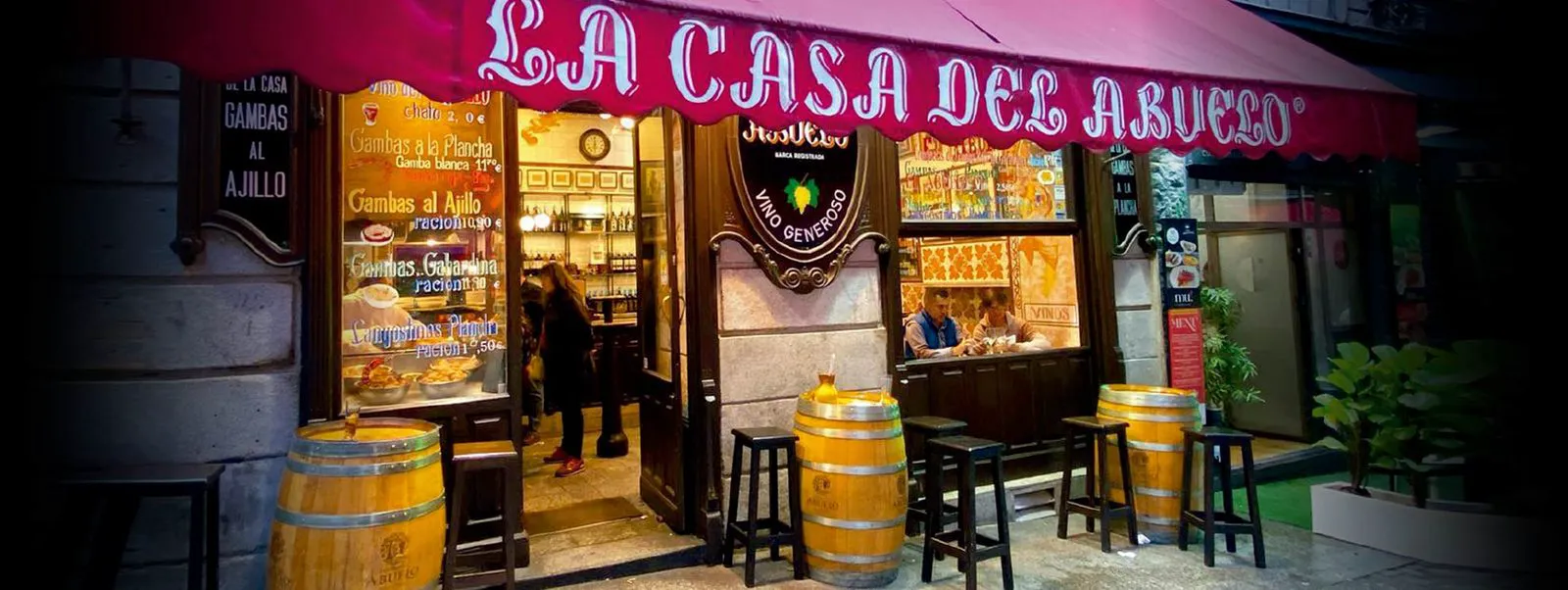
La Casa del Abuelo (Calle de la Victoria, thirty seconds off the square) has been open since 1906 and there is only one thing to order: gambas al ajillo, brought to the counter still spitting in its little metal pan, garlic and chilli and oil you are meant to mop with bread until the pan is clean. Budget €12–18 a head for the prawns and a drink. That is what good prawns cost rather than a tourist mark-up, and the bread is not optional.
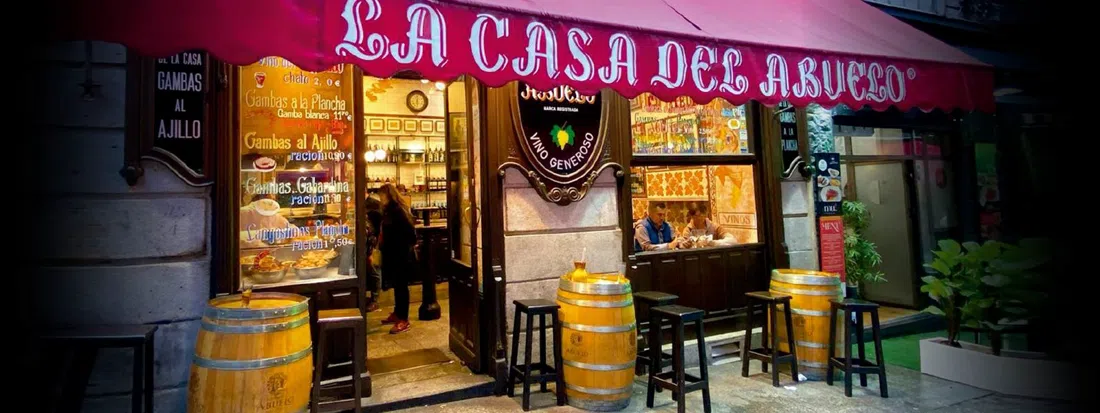
No reservations, first come first served, and the original Victoria 12 room is genuinely small: a bar, a strip of standing space, elbows. Two or three people will get in within minutes at 7.30pm. Four is the practical ceiling. Above four, split into two pairs or use one of the operator's other rooms a few doors along, which run under the same name and the same kitchen; the one entry covers the cluster. If you arrive at nine on a Saturday and the doorway is three deep, walk the loop and come back at ten, because this is the one address in the article I would wait for.
A five-minute stop for patatas bravas
Las Bravas (the Álvarez Gato alley, a minute east of Sol) has been trading since the 1930s and holds a patent on its sauce dating from 1959. It is a specialist rather than a restaurant: fried potato, that sauce, standing room, €5–12 a head, and a turnover so fast that a space usually opens up before you have decided what to drink. Walk-in only; no bookings exist to make.
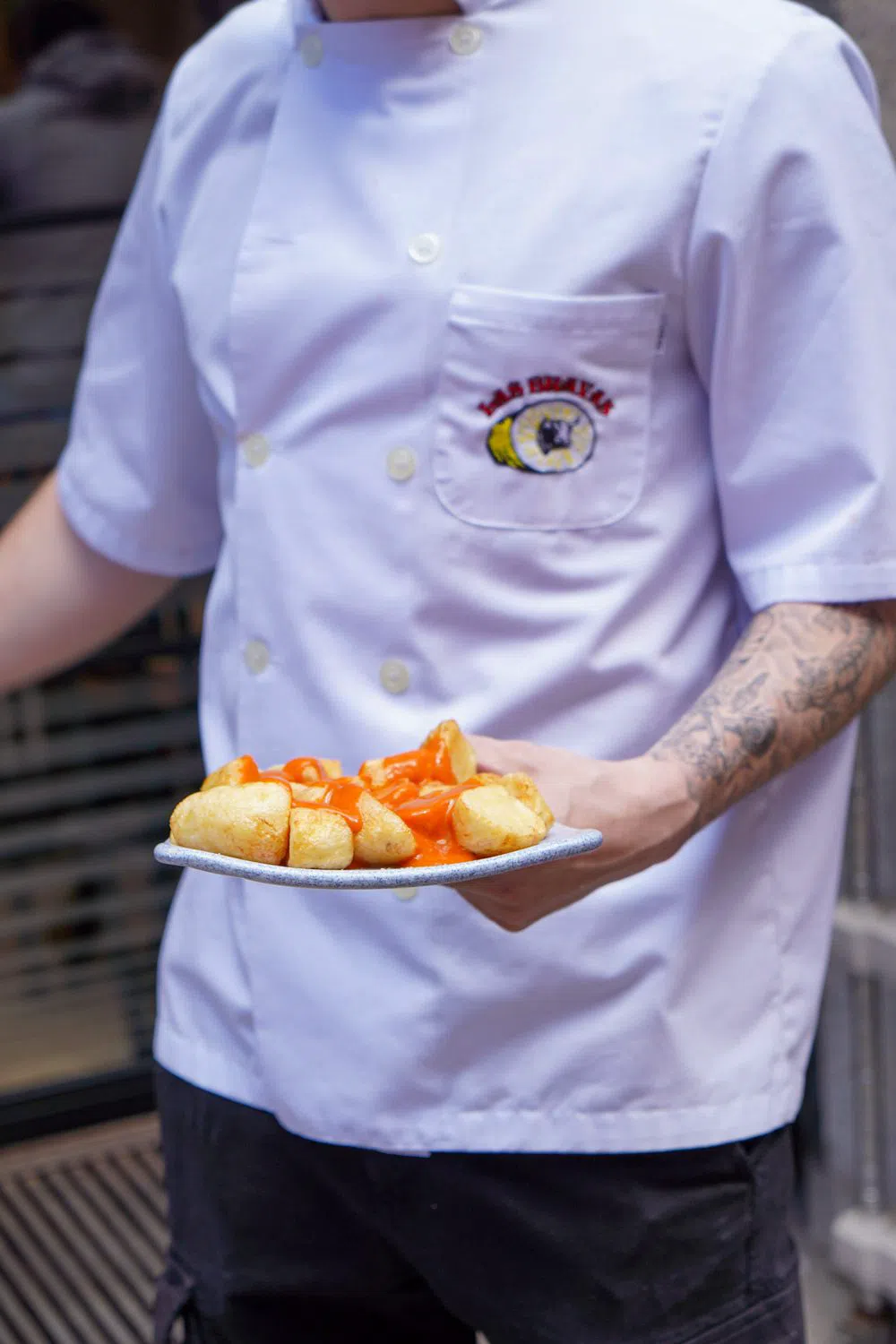
Treat it as a five-minute stop between two better meals. Couples and pairs do well here. A group of eight will end up standing out in the alley with plates balanced on forearms, which is survivable but not an evening. While you wait, look at the distorting funhouse mirrors mounted on the alley wall next door. They are a real Madrid fixture rather than a prop someone installed for photographs, and they are free.
The one address that can swallow a group of ten
Museo del Jamón on Carrera de San Jerónimo (the square's eastern lip) is not a museum, whatever the name and the ceiling full of hanging legs suggest. It earns its place for one reason: it is the only address right on Sol that can absorb a party of ten at any hour without a phone call. Large halls, tables upstairs, continuous service from 9am to past midnight, no booking.
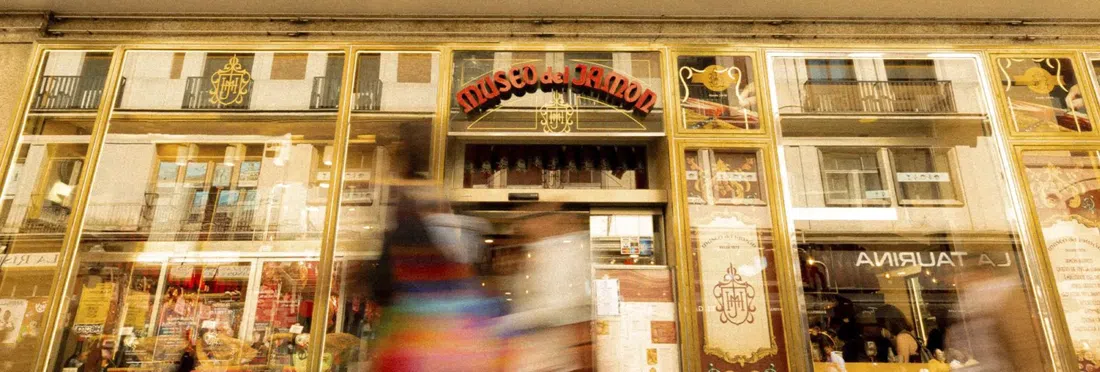
Prices split cleanly. A ham roll at the bar is €1.50–3, and a counter bocadillo with a caña is the cheapest honest lunch anywhere near the square: a ham sandwich and a small beer eaten standing up, the way half of Madrid does it. Sit down upstairs with a plate and you are at €15–25 a head. It suits groups too big for the counters, families, anyone arriving at 4.45pm when the serious kitchens are shut, and anyone who needs to eat before a train.
Two centuries of dining room for the price of a coffee
Lhardy (Carrera de San Jerónimo, two minutes east of Sol) has been open since 1839 and offers the sharpest door-price contrast in these streets. Downstairs is a self-service standing room with a samovar: you walk in free, take a cup, pour your own consommé from the urn, and pay about €4. A two-century-old room and a hot cup of broth for less than a cocktail, and on a cool October evening that is the best value-for-history ratio in this article.
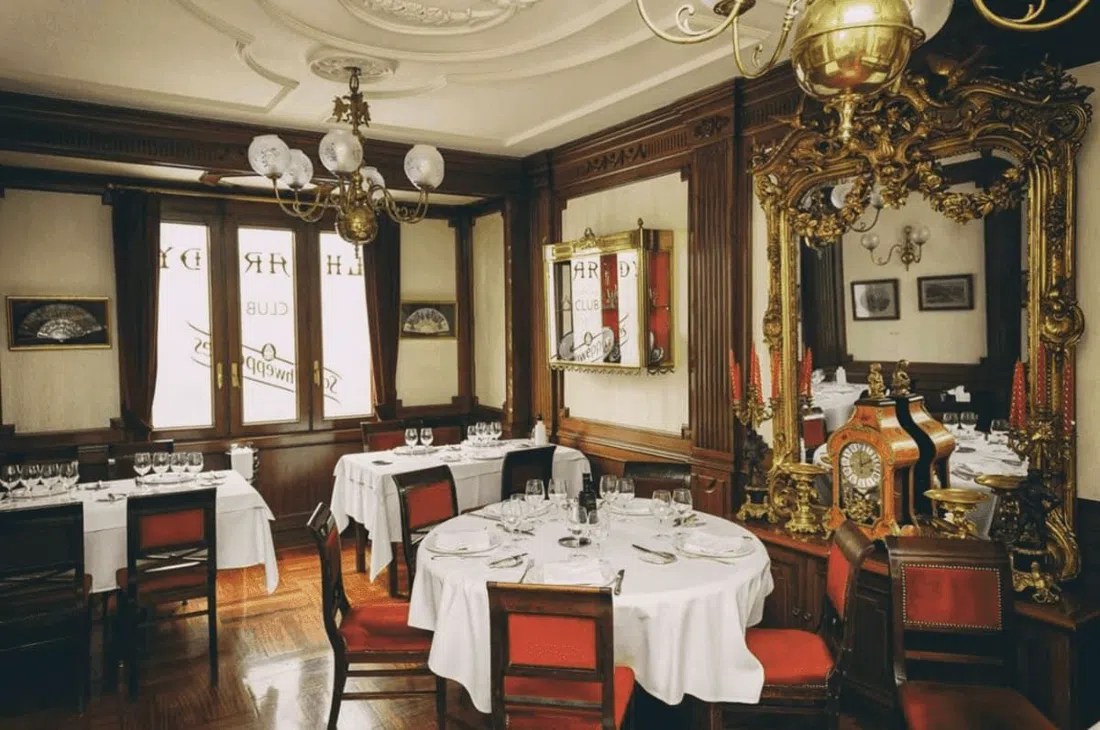
Upstairs is the other Lhardy: booked dining rooms, website or telephone only, no walk-ins for groups, and €60–90 a head for cocido madrileño served in its traditional courses. If that is your one big Madrid meal, book it well before you fly; the upstairs rooms are small and the cocido is why people come. One clarification worth making, because the internet has not caught up: the newer Lhardy Café on Calle Velázquez is a sister site. The cocido stays here.
Churros at eight in the morning, pastries at six in the evening
Chocolatería San Ginés (the passage off Calle Arenal, five minutes from Sol) has been serving since 1894 and is the only genuinely round-the-clock food stop near the square, open continuously Thursday to Sunday. Six churros and a chocolate thick enough to stand a churro upright run about €5–6. No bookings; capacity across two rooms and the passage tables means a group of ten gets in.
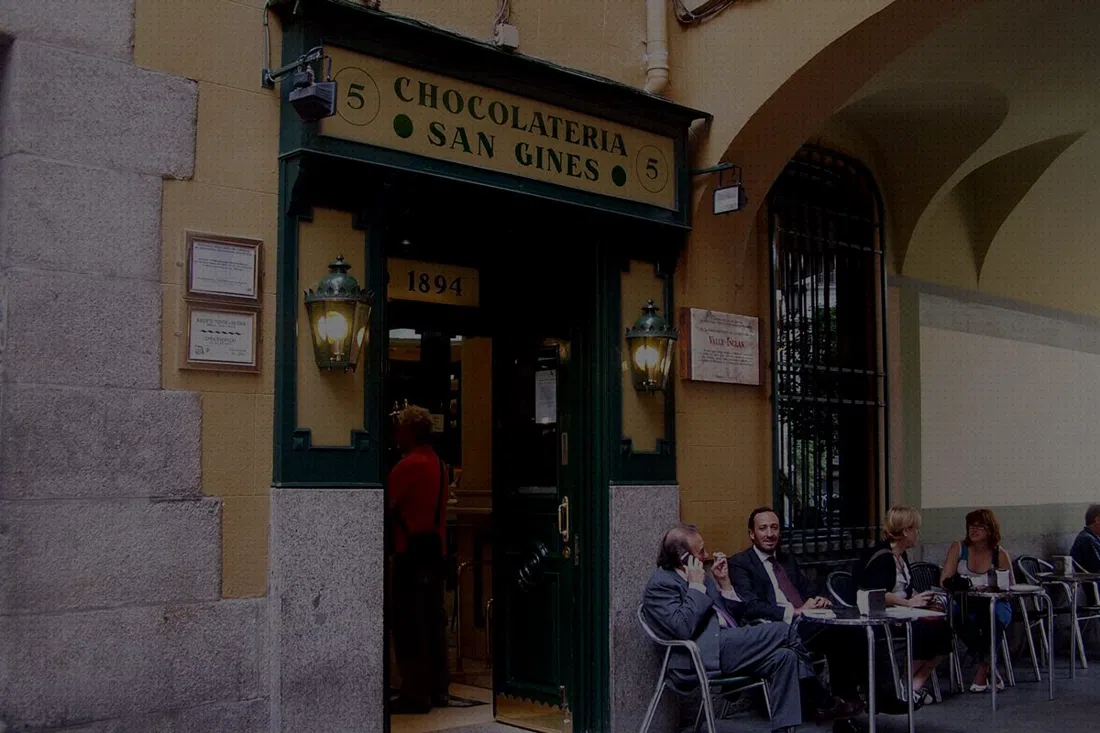
The timing advice here is the whole point. Mid-evening the queue outside is long and is not itself an experience. Go at 8am before anything else opens, or at 2am on your way back from wherever the night went, and you walk straight to a table. Both beat the 7pm version.
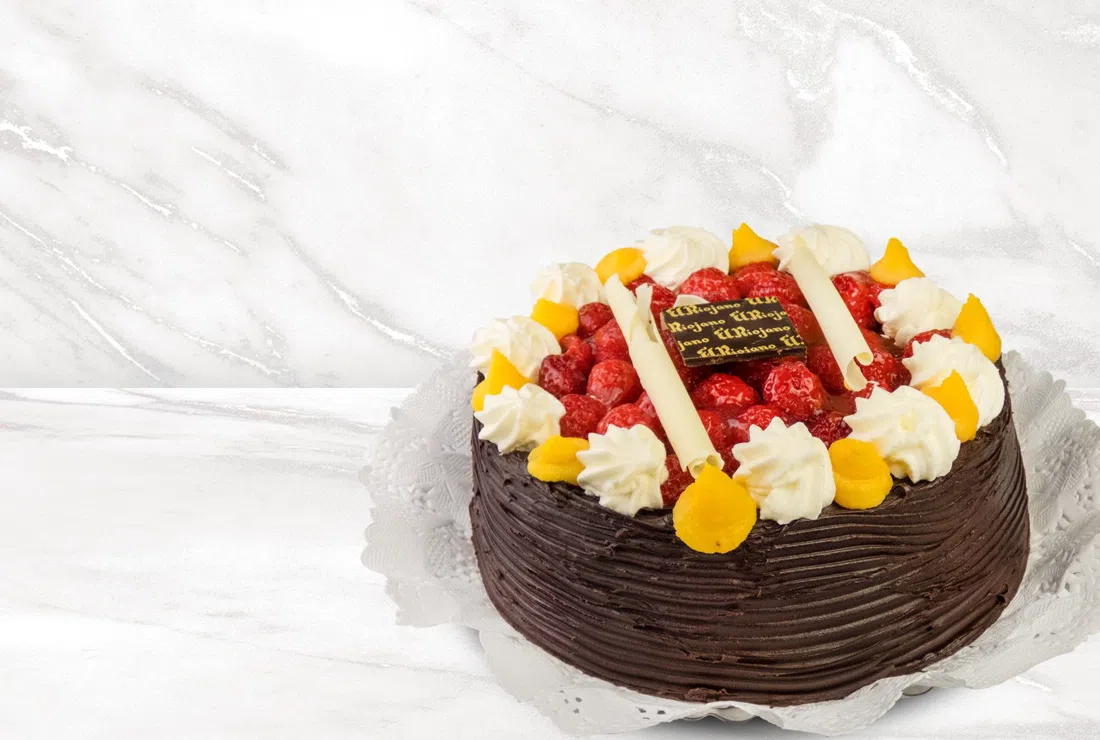
Pastelería El Riojano (Calle Mayor, three minutes from Sol) is a shop rather than a café, founded in 1855 by a pastry chef from the Royal Palace, with the best-preserved interior of any of these doors and only a couple of standing spots inside. Buy the pastel de yema, €2–5, and eat it walking. That makes it useful in a way cafés are not: it is open 9am–9pm daily, so it covers the dead afternoon when the taverns have shut their kitchens and you need something in your hands.
The market reopened in February, so ignore the old photographs
Mercado de San Miguel (Plaza de San Miguel, by Plaza Mayor, eight minutes from Sol) reopened on 26 February 2026 after a multi-year refurbishment, so any coverage or photo set older than this spring describes a hall that no longer exists. Entry is free, small plates run €4–8, and a realistic bill once you have drifted past four stands is €15–30 a head. It stays open to midnight, and to 1am on Friday and Saturday, which makes it a real late option rather than a theoretical one. Stools are scarce at peak; some individual stands take reservations through the market's own booking page.
An honest verdict, because this is the address built most squarely for visitors: I would not send you here for dinner. The per-plate prices are display prices and the pleasure thins out fast. It works for one plate and one glass at an off-hour, or for a group of six who cannot agree on a cuisine and would rather all choose separately. Go in knowing that and you will not resent it.
Six euros buys the best light near Sol
Azotea del Círculo de Bellas Artes (Calle de Alcalá, six minutes from Sol) charges €6 for the lift up, €5 reduced, with drinks on top at terrace prices. It is the clearest door-price comparison in the area: a few euros for a managed-capacity rooftop with the long view over the rooftops towards the west, against the cost of any guided alternative.
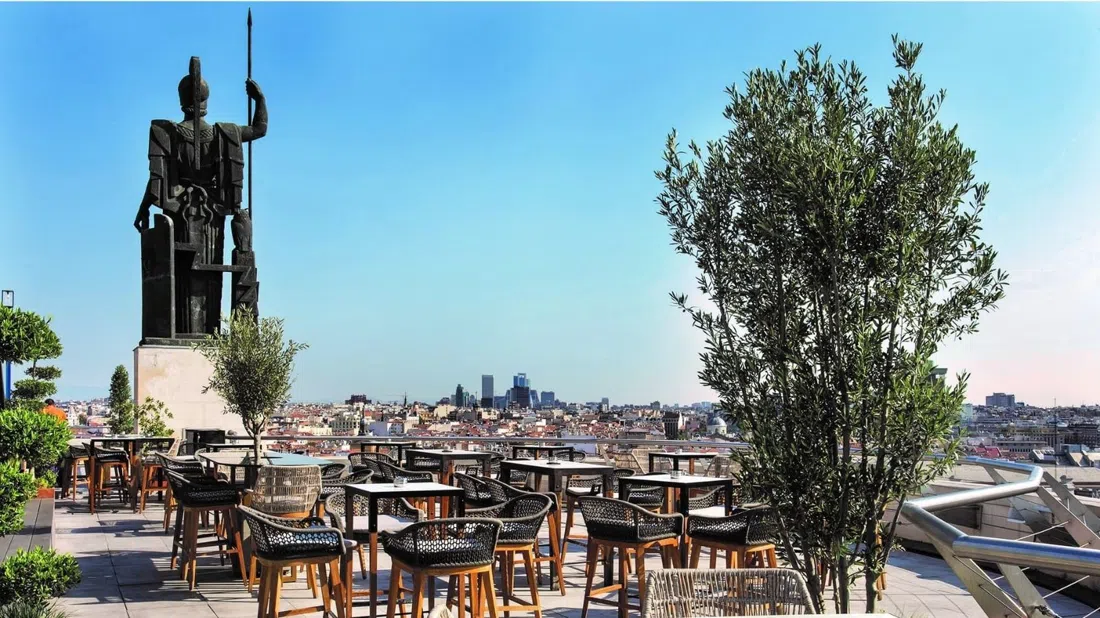
Two rules matter. The ticket gets you onto the roof, not onto a terrace table, so if you want to sit with the view at golden hour, arrive at least forty-five minutes before sunset; the rush is predictable and the staff cannot invent tables. And tickets are sold online except between 2pm and 4pm and after 9pm, when you have to buy at the building's reception desk downstairs. Build this into the start of a tapas evening rather than the end: up at golden hour, down to a counter by eight.
What the door costs against a guided walk
Run this yourself and the arithmetic is straightforward. Prawns and a drink at €12–18, bravas at €5–12, a counter bocadillo and a caña at a few euros, a €4 consommé and churros at €5–6 puts a full self-directed evening somewhere around €30–45 a head, more if you drink properly. Nothing on that list needs a reservation except the Lhardy dining rooms.
There is also a guided tapas-and-history walk through these same streets, and the demand for it is real rather than manufactured: across the bookable options here there are 8,997 traveller reviews, with the top walk rated 5.0 out of 5 from 3,625 reviews. It runs seven days a week, so October dates are not a scramble, and it starts from 72 USD per person. Roughly double a self-run crawl.
额外付费的价值在于:获得点单的信心、由他人替你处理排队等决定,以及那些否则只能从铭牌上读到的背景知识。若这是你在这座城市的第一晚,若你不会西班牙语又不喜欢瞎猜,或者你是五人及以上的团体(否则每过一个柜台都会被拆散),那么这笔钱就花得值。若你已习惯站在吧台边,指着旁边人正在吃的东西点单,那就不必付费,马德里人自己就是这样吃的。
十月的最佳时段
周二至周四的工作日中段是一周中最理想的时候:从大约晚上7点半起,吧台坐满当地人,但你不必争抢站位。周五和周六晚上8点至10点是人流高峰,依然热闹,但你得在La Casa del Abuelo排队,在Las Bravas则要站在小巷里等。周日下午较为清闲,大型火腿厅最能从容应对。
一天中的时段比日期更关键。下午1点至2点的吧台午餐便宜、安静,是团体最容易安排的时间。大约下午4点半至6点半,许多厨房停止营业,这正是糕点店和站立式清汤房派上用场的时候。晚上7点半开始逛,接受9点半是最拥挤的时段,并把24小时吉拿棒和深夜市场作为备选。
月内光线变化明显,这对屋顶露台很重要。日落时间从第一周的约晚上7点45分,到第四周末约晚上7点25分;十月最后一个周日拨回时钟后,日落提前到刚过晚上6点15分,因此十月下旬去屋顶露台,应安排在晚餐前,而非代替晚餐。午后通常暖和到可以穿着衬衫站在户外;入夜后气温迅速下降,请带上一件外套。可能会下雨,除屋顶露台外,这里列出的每个地点都在室内。
实用信息
交通:Sol是地铁1、2、3号线的换乘站,下方还有Cercanías(近郊铁路)车站,因此你几乎可以从城市任何地方不换乘直达。这里提到的所有地点从该站出发都步行可达,最多十二分钟,路面平坦,部分路段铺有鹅卵石,所以别穿高跟鞋。
付款:多数地方都可刷卡,但请备好20欧元的小面额纸币和硬币,用于吧台点单和吉拿棒,因为如果要八人分账刷卡,恐怕不会受欢迎。通常在结账时一次性付款,而非每杯单独付。
预算:15欧元可以吃一个吧台上的小三明治(bocadillo)、一杯生啤(caña)和吉拿棒。30至45欧元足以享受一场完整的小吃之旅,包括虾和土豆辣酱。每人60至90欧元是楼上预订的Lhardy马德里炖菜,那是另一种完全不同的夜晚。
最后两点提醒。Sol是城市里最繁忙的扒手出没地之一,尤其是在热门吧台门口的拥挤人群中:把钱包放前面口袋,包包背在身前,后口袋里别放东西。若可能,请住在步行范围内,因为离这些门口只有十分钟步程,是能否再来一轮还是得打车的区别。在Sol为中心搜索马德里酒店,即可看到十月份的住宿价格。